


The other day our family made the long trek up to the small cottage in New Scotland where, ever since 2004, we’ve lived for three months of the year. “New Scotland?” you ask. Yes, that’s after all what Nova Scotia means. By now we’ve got a lot of old friends here, because on our island everybody knows everybody by sight or by family or by reputation. In general, I think that unless you’re talking about farmsteads separated by hundreds of acres, or tiny villages scattered in a wilderness, the less densely populated a place is, the easier it is to make friends. It’s why cities can be such terribly lonely places. It’s why, once a high school reaches a certain size, let alone a middle school or elementary school, a sense of belonging to that place begins to fade, and anonymity and loneliness rise up. But the countryside isn’t that way. Or so I found it one summer when I sold expensive and high-quality cookware and china door to door: people in farm villages were a heck of a lot friendlier than the people in the towns, and that more than made up for the extra driving I had to do.
So here we are in Canada, our Word of the Week — but, my fellow Americans, you can no more suppose that all Canadians are alike than you can suppose that joggers in the Boston Commons are just like ranchers in Texas. Toronto may as well be on a different planet, as far as our friends here are concerned! The people on our island come from three or four main groups. More than half are French, and about half of those are native French speakers, though the young people aren’t nearly as fluent as their parents are. Most of the rest are Irish or Scots; a few are Basque (with surnames like Goyetche and Baccardax), and some are Jerseymen, from that channel island full of French speakers under British rule. Quite a few people have Mikmak blood, too, especially the French, because the relations between the Mikmak and the French were friendly from the start. The sachem Membertou, a great and wise leader who as a young man had met and befriended the explorer Jacques Cartier, was baptized on June 24, 1610, taking the name Henri, and his people followed his lead. That was, by the way, when Membertou was 103 years old. Things went well for more than a century, till the area was embroiled in the conflicts between Great Britain and France, and the people of Acadia — what the Francophone coastal areas of Newfoundland and Nova Scotia were called — were expelled by the British in the 1750’s. Many of them ended up in Mississippi and Louisiana — hence the name Cajuns, from the Acadians. Some years ago there was a big general family reunion and festival up here, with people of French descent from the United States returning to their ancestral villages: people with names like Boudreau, Boucher, Le Blanc, Landry (that is, L’ Andre), Martel, and so on. We were happy that such a celebration could still come off. And we are very happy indeed that the diocese failed in its attempt to shut down what had once been the cathedral church, Notre-Dame de L’ Assomption, in our opinion the most beautiful church in all of Cape Breton. Our son Davey has often played the old pipe organ there. To say that the church is full of history is an understatement. Several of the early pastors are buried in the church itself, with gold lettering inscribed in the marble stones to identify them and keep them in memory.
If you ask us what we like best about Canada, we’ll say straight off that we like the people here, and I do mean here, and as I look out of my window upon the bay, I’ll add that the quiet beauty appeals to me too. The government? No, we’ll pass on that. But since when is the real heart of a people to be found in their government? I took our dog Molly for a walk down our road yesterday, and found to my delight that the saskatoons are ripe and haven’t yet shriveled up or fallen off the trees. The saskatoon is a small pome, from red to purple-black, very sweet and juicy, with a flavor like that of a cherry dashed with a bit of amoretto. The city in Saskatchewan was named for the fruit, not the other way around. The blackberries are still green. I need to check out what are called “foxberries” up here, but in Sweden are called lingon — the lingonberries, a variety of cranberry, richer in flavor and slightly sweeter. And the black cherries — though the crows have probably gotten them by now. The blueberries are probably past, but I’ll be checking that out too. There’s a wild black currant bush behind our barn here, and a couple of wild gooseberry bushes. A lot of raspberries — but they are gone by now. Bilberries also grow up here, as I discovered once when our dog Jasper, that brilliant pooch who gave us so many cheerful memories, ate them off a bush before I could stop him. I then said, “If they’re good for a dog, they’re good for me,” and sure enough, they were.
The people, their songs, their worship; the humble soil underfoot, the trees and flowers, the birds like the great blue heron I saw in the lagoon today, the history, the language, the old customs of work and neighborly help — if only they can survive, because children here aren’t outdoors nearly as much as they ought to be — these are what make for me the charm of a country. I can now pick out a Canadian from their peculiarly raised vowel in words like park and car, and their other peculiarly raised vowel in words like house and mouse, the latter heard in the United States only in the Shenandoah Mountains and valley — hear it in the narrator Earl Hamner, in the old show The Waltons. I am delighted by the long and warm friendship between our countries, delighted to know that the Hall of Fame pitcher Ferguson Jenkins was Canadian (from Swift Current, Saskatchewan), and the Hall of Fame outfielder Larry Walker is Canadian (from Maple Ridge, British Columbia), and the Hall of Fame second baseman, Napoleon Lajoie (pronounced LAJ-way), from Woonsocket, Rhode Island, was French Canadian, just like Davey’s organ teacher, Henri Saint-Louis: they both grew up speaking Woonsocket French. The greatest impersonator in my lifetime, Rich Little, still with us, grew up in Canada — and there must be something in the water up there, because so did Martin Short, Dan Aykroyd, and Jim Carrey, all terrific impersonators.
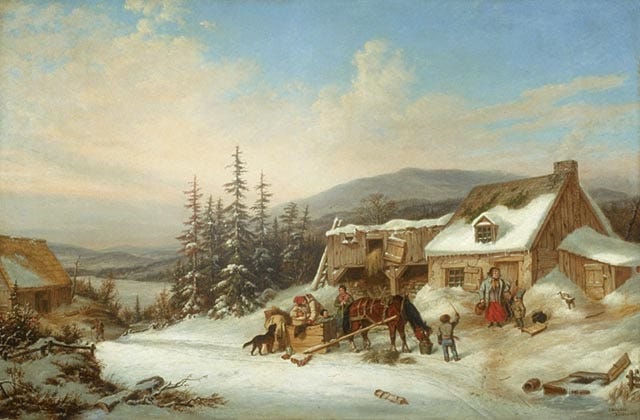
“But what about the word?” you ask. I thought when I was a kid that it had something to do with the snow, because Latin candidus means shining white: and yes, the candidatus, from which we get our word candidate, has bleached his toga so he could shine in front of the people. But that’s not where the name Canada comes from. It’s from a word meaning “village,” in a now lost native language in the Iroquois family: something similar to Mohawk kanata, and Onondaga ganada-ye. It’s odd, isn’t it, that the name of a nation of almost 4 million square miles should come from a word for village!
We think of our archive as a little treasure trove. Our paid subscribers have on demand access to the entire of Word & Song, many hundreds of entries. For everyone else, there’s always plenty to see here, as well. We hope that all of our readers will revisit and share our posts with others as we continue our mission of reclaiming — one thing at a time — the good, the beautiful, and the true.


