


Congratulations to all our readers or children of our readers who are graduating from high school or college. Onward and upward!
In the 1800’s and the early 1900’s, if you earned a high school diploma, our Word of the Week, it meant that you were capable of reading pretty much any English novel or poem in print, and any of our high-quality all-purpose magazines (The Century, Harper’s, Scribner’s, The Atlantic), and any book but those for which special and technical study was required: all histories, biographies, travelogues, religious or political treatises, and so forth. But a lot of people who did great and important work in arts, letters, and the sciences never got a diploma at all. Edison didn’t. James Fields, one of the principal partners in the tremendously successful and high-aiming publishing house Ticknor and Fields, was apprenticed to a bookseller in Boston at age 14, without a diploma. John D. MacArthur, who built up the insurance company my father was proud to work for, Bankers Life & Casualty, sometimes called “White Cross,” dropped out of school in the eighth grade. He’s the MacArthur whose foundation gives out the so-called “genius awards” every year, but for my family he’s got another reason for our attention: he was the uncle of James MacArthur, whom you may remember as Danny Williams (“Book him, Danno!”) in the terrific police show, Hawaii Five-O. Danno’s (adoptive) mother and father were the celebrated actress Helen Hayes and the playwright Charles MacArthur.
I got my high-school diploma from Bishop O’Hara High School, in Dunmore, Pennsylvania, and in my library I’ve got the doctoral dissertation of that same William O’Hara, published as a book, on the materialist philosophy of Herbert Spencer. O’Hara was the first bishop of Scranton, presiding from 1868 to 1899. We weren’t taught anything about him, not that I remember, but the school still offered classes in Latin, German, French, and Spanish, and everybody had to take at least two years of one of those; and you could take Latin also in place of history if you chose. I did so choose, taking two years of Latin and three of German. And of course, when we graduated, we wore the scholarly gowns and the caps with the tassel, which in our case were blue and gold, the school’s colors. Father Kenneth Kizis, the founder and principal of our school, gave out the diplomas, and somewhere my mother has a picture of me shaking his hand as he gives out the award, both of us beaming broadly. I’d soon be going to Princeton — another world entirely, and another diploma.
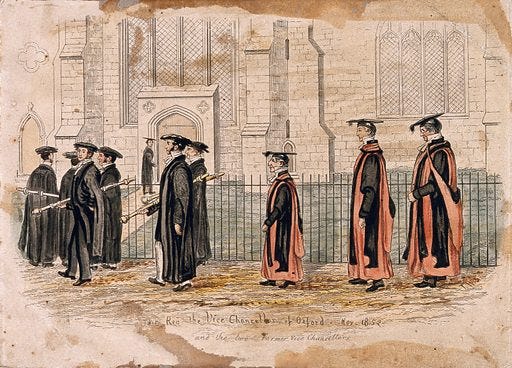
A lot of our traditions surrounding high school and college ceremonies come from the Middle Ages and the universities they invented. There were schools before that, of course, but here’s the thing. The university was a guild of scholars, who, like the men of other guilds, guaranteed the character and the high quality of their work. Now then, you could see what goldsmiths or glaziers made and judge their work accordingly, but that wasn’t possible for scholars. To judge and guarantee and direct that kind of work, you needed a stable and powerful institution that spanned all the nations, and a broad and deep fund of knowledge and scholarly thought, spanning — as it was even at the time — almost two thousand years. That institution, of course, was the Church. So there was indeed something sacred about the examinations, often conducted in public, in the open air, with a great deal of solemnity and real excitement, and one sign of the sacred was that the doctors and the masters and the students wore special robes. One of the wisest college professors I ever met taught at the University of the South (Sewanee, as it’s familiarly called), and for his ordinary classes he wore the scholar’s black robe. He wasn’t showing off. It was an act of humility, actually. It meant that what they were doing in class was more important than he was, and more important than they were. True enough!
But the word diploma really does suggest not only the sacred, but the secret: what good is a diplomat, after all, if you can’t trust him with state secrets? A diploma was a state document, a sort of license or a letter of commendation, held by someone traveling to carry out important business; or it was a charter drawn up by the ruler; or it was a document held in high institutional regard. It was called a diploma because it was often a paper folded double, which is what the Greek word meant. Such a diploma was likely sealed with wax and stamped with the ring of the sender. It wasn’t what you’d hang on your wall! The plural, by the way, was the Greek diplomata, but early on that began to be supplanted by the form diplomas, in the ordinary way of making English plural nouns.
The diplo- part of the word comes from two main roots, and both are extremely productive right across our language family. The first is the di-, suggesting two, and that’s in fact a cousin of our word. Grimm’s Law instructs us to look for Germanic t as the descendant of Indo-European d: so for example we have Latin decem, but English ten, and Latin digitus, but English toe, and Latin Deus, but Old English Tiw, the sky-god whose name is preserved in our word Tuesday, that is, Tiwes-daeg, “Tiw’s Day.” The second is the pl-, from the root pel-, suggesting a fold, and that too is a cousin of our word. Grimm instructs us again to look for Germanic f as the descendant of Indo-European p: so for example we have Latin pater, but English father, and Latin pes, but English foot, and many, many other pairs to boot. So think of a diploma as a double-folded paper, as if it were a duplex — to steal the Latin word that is exactly analogous to it, or as if it were two-fold, the English word. Sometimes it’s a sneaky thing to be two-fold: that’s what duplicity is all about, and nobody likes a double-dealer, and a double-cross is an act of real treachery. But none of that sense attaches to the diploma. Or even to the diplomat, who often has to speak politely what might else offend. It’s good to be diplomatic, and good to earn a real diploma. Again, congratulations to everyone here who has recently done so!
We think of our archive as a little treasure trove. Our paid subscribers have on demand access to the entire of Word & Song, many hundreds of entries. For everyone else, there’s always plenty to see here, as well. We hope that all of our readers will revisit and share our posts with others as we continue our mission of reclaiming — one thing at a time — the good, the beautiful, and the true.


