


Dear Readers — here’s a change of pace today!
Suppose you are introducing people to a kind of music that’s unfamiliar to them. That might be easy or hard to do, depending on the music’s immediate appeal — I can hardly imagine somebody not responding to a melodious love song like “The Gypsy Rover,” or to Stephen Foster’s profoundly sad remembrance of his wife who left him, “I Dream of Jeannie.” But if the music is especially complex or subtle, or if it doesn’t give you a melody to hum or to whistle, you might have to train your ear and mind and heart. That’s where you need patience, a kind of silence inside yourself, a willingness to wait, to open yourself and say, “I’m listening.”
Here I’ll make a confession. I’d taught Renaissance literature for more than 15 years, when one of my dearest friends gave me a CD with the sacred music of the Renaissance composer Thomas Tallis. I expected to hear ballads and carols and stanzaic hymns, with bold Renaissance chords. Those I could make “sense” of — I knew what they were like. I didn’t expect the 40-part (that means forty voices singing forty different melodies simultaneously) motet, Spem in Alium. I’ll be honest, I didn’t know what the heck I was listening to. I was puzzled and disappointed. It took me quite a while to appreciate what Tallis was doing, and that was only after I’d first learned to listen to Palestrina.
So what does this have to do with poetry? Quite a lot! I sense that teachers — especially those who cut their teeth on modernist poetry without rhyme or meter — are so worried that their students won’t be able to make heads or tails of a sentence in poetry, they miss teaching them how to listen to the music. And if we’re talking about free verse, there sometimes isn’t any grammatical sense, or even any music — but that’s another matter. Walt Whitman wrote free verse, but he was always musical. Whether or not you like what he does or feel for what he says, he’d cut his teeth on the music of European poetry going back to Greece and Rome, so even when he’s writing free verse you often hear the rolling thunder of the old epic meter just beneath it. Anyway, it’s as important to hear the music of a poem (and poetry ought to be musical, in a broad sense) as it is to furrow your brow over the symbols and the metaphors. By the way, it’s one reason why Debra and I can’t stand the jiggering that editors do with old hymns. Meaning aside, changing thee to you is like somebody saying, “Oh, don’t have the flutes play that measure. Use the tuba instead.” Hey, that ain’t the same thing.
Now, for today’s Poem of the Week, thinking of our key word, favor, I have a haunting passage from Milton’s Paradise Lost. The scene is this. Adam and Eve have eaten the fruit; they have felt the shame of their sin; they have blamed each other, estranged and in enmity; they have been judged, firmly but mildly, by the Son of God; they have wept and been near to despair; but God has sown contrition in their hearts, and they are now reconciled to one another in love and sorrow. Eve has suggested to Adam that they remain childless, so that the curse of death will end with them, but Adam has rejected the suggestion, thinking hard, trying to remember the promise that the Son has also given, that the seed of the woman shall bruise the serpent’s head. He also remembers the mild and gracious temper of the Son when he judged them, the favor that shone in his face, so he recommends that they trust God, weep for their wrongdoing, and pray for mercy.
Here’s the musical question I want to ask. What Milton does here at the very end of Book 10 is pretty daring. First, Adam recommends to Eve that they do what I’ve mentioned. Second, he gives the great reason why they should be confident. Third, Milton, in his own voice, describes what Adam and Eve do, using almost exactly the same words, the same clauses, the same rhythm of phrasing, that Adam has just used — daring to repeat himself, seven whole lines. How can he get away with that?
Or rather, what has he just done, stunning us in so doing? What do you feel is the musical effect of it — and I mean also the dramatic effect, as if we were at an opera, and the repetition was integral to the moment? I’m really asking how it strikes you. I know, when we’re talking or thinking about not just what words mean, but how they sound, and not just one word here or there, but seven lines together, it may be hard for us to be precise about it, but the power of all great art far transcends precision. As for me, I think the effect is solemn and quiet, rather like the end of Bach’s oratorio, Jesu, Meine Freude, whose last line is the first one repeated, but after so much has come between — in English, “Jesu, priceless treasure.”
So then, tell us what you hear — what you feel.
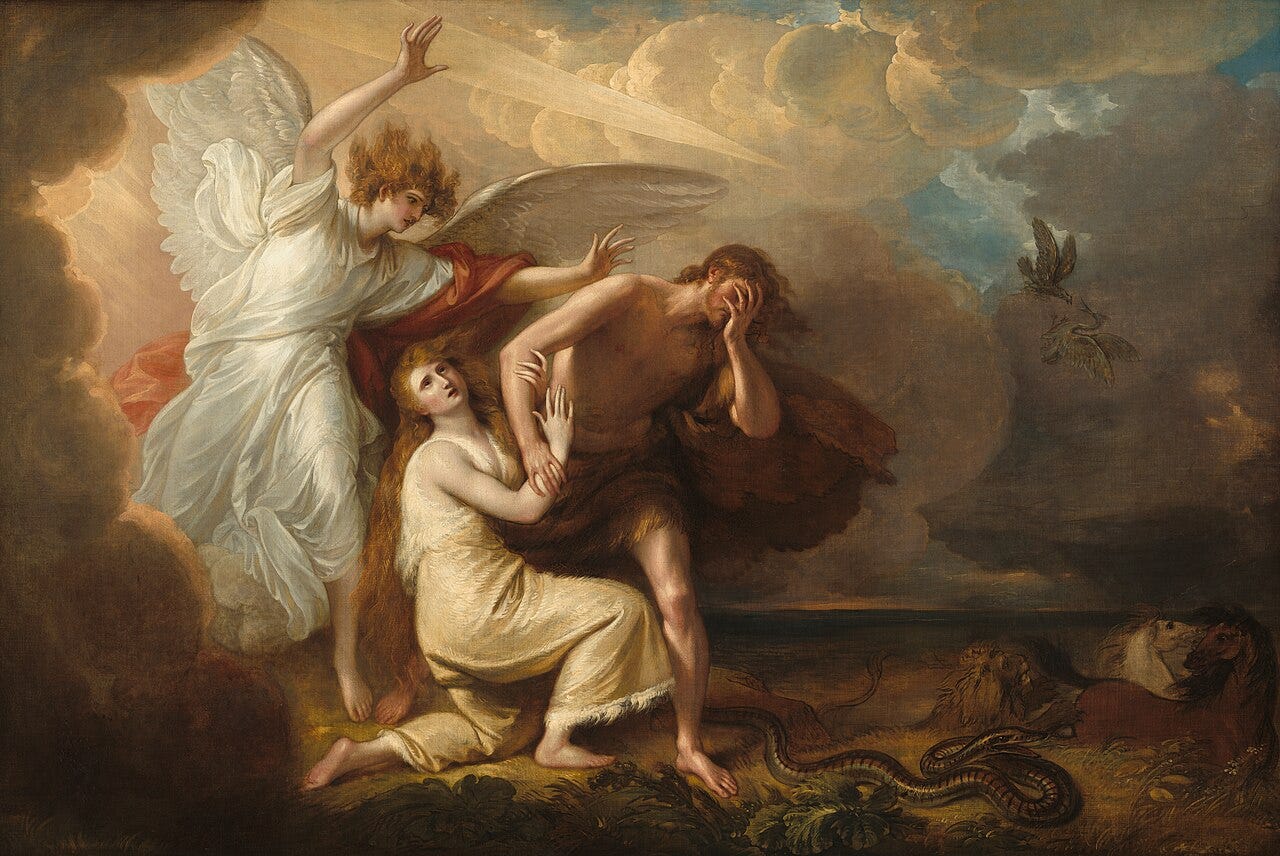
          ". . . Such fire to use,
And what may else be remedy or cure
To evils which our own misdeeds have brought,
He will instruct us praying, and of grace
Beseeching him, so as we need not fear
To pass commodiously this life, sustained
By him with many comforts, till we end
In dust, our final rest and native home.
What better can we do than to the place
Repairing where he judged us, prostrate fall
Before him reverent, and there confess
Humbly our faults, and pardon beg, with tears
Watering the ground, and with our sighs the air
Frequenting, sent from hearts contrite, in sign
Of sorrow unfeigned, and humiliation meek.
Undoubtedly he will relent and turn
From his displeasure, in whose look serene,
When angry most he seemed and most severe,
What else but favor, grace, and mercy shone?"
     So spake our father penitent, nor Eve
Felt less remorse; they forthwith to the place
Repairing where he judged them, prostrate fell
Before him reverent, and both confessed
Humbly their faults, and pardon begged, with tears
Watering the ground, and with their sighs the air
Frequenting, sent from hearts contrite, in sign
Of sorrow unfeigned, and humiliation meek.
Word & Song is an online magazine devoted to reclaiming the good, the beautiful, and the true. To support this work, please join us as a subscriber.
We think of our archive as a little treasure trove. Our paid subscribers have on demand access to the entire of Word & Song, many hundreds of entries. For everyone else, there’s always plenty to see here, as well. We hope that all of our readers will revisit and share our posts with others as we continue our mission of reclaiming — one thing at a time — the good, the beautiful, and the true.


