
“It’s the Bread Man!” I’d call out to my mother when she asked which truck it was on our small dead-end street. It could have been the Coal Man with a delivery down the chute into the coal bin in our little basement. It could have been the Charles Chips man with potato chips that still tasted like potatoes, in the big brown and yellow cans. If it was the driver for Mr. Lucci the baker, the air from the street would have that wonderful warm smell of fresh bread, lingering for a while after the truck was gone. I’ve met people who don’t like cherries, or onions, or spinach, or turkey, or cold cuts (I don’t like cold cuts), or cheddar cheese. I have never met a single person who did not like bread, our Word of the Week.
Real bread is a fine thing indeed. And it was the basis for all ancient civilizations. Think of it: made from high-protein grains, rich in calories, portable as loaves or wafers, not needing to be eaten right away, not even needing to be made right away, since dry grain could be stored in granaries for a very long time, as the patriarch Joseph’s advice to the Pharaoh during the seven fat years shows. It had this crucial practical effect: not everybody had to be employed in procuring and preparing food. You could have that division of labor you need for masons, woodcutters, carpenters, weavers, wheelwrights, potters, smiths, soldiers, scholars, governors, and so forth. So we find barley at the heart of the civilizations between the rivers Tigris and Euphrates, and wheat at the heart of Egypt, and rice at the heart of China. And if you looked in my backpack when I was a young fellow traipsing around through Italy for the first time in 1983, you’d likely find a loaf of good fragrant chewy Italian bread, the kind with a nice lightly oiled crust, with maybe a hunk of mozzarella cheese, and a couple of pieces of fruit, enough to last me through till supper.
Bread, “the staff of life” as Scripture calls it, is so obviously the basic food, that you will find all kinds of phrases in which bread stands for sustenance in general, as “food.” So we pray, “Give us this day our daily bread,” not our daily milk or lamb chops. The breadwinner in the family was the one who earned what was needed to feed everybody, and about two hundred years later, “bread” arose in American slang to refer to money — what you could use to buy bread; see also “dough” for the same idea. When Jacob and his sons and their huge family went to Egypt, they did it not because they liked Egyptian ways, and they certainly didn’t know that Joseph was the Pharaoh’s chief minister. They did it because there was bread in Egypt. Even in Anglo-Saxon England, which wasn’t the Great Plains of America, the hlaf — our word loaf — was so essential, that the chief in charge of making sure that people had loaves to eat was called the hlaf-weard, the loaf-warden, shortened to Anglo-Saxon hlaford, which is the origin of English lord.
Where does the word come from? There are two main guesses. The less likely is that it’s related to words having to do with seething or boiling, in which case it would be a cousin to the word brew. The Babylonians would approve of that one. They not only made barley bread. They invented beer. Not for individual drinkers, mind you. They’d brew a big tub of it — think of foamy liquid pumpernickel or something — and people would sit around the tub, drinking it in common through good stout reeds. The idea is similar to what we find in the late Latin word companio, a friend, a fellow traveler, literally the fellow who shares your panis, your loaf of bread. Bread should bring people together, but Juvenal, in his famous tenth satire, looks askance at bread if you seek little more. The phrase he used has entered our language, touched with his scorn. So then, in the days when the treacherous Sejanus was secretly taking over the Roman state while his boss the emperor Tiberius retired to Capri, that grand Roman populace which once conferred command, legions, and the fasces — their symbol for unity and the force that could punish transgressors — were now truckling to Sejanus, who gave them “bread and circuses.”
But the other guess about the word’s origin seems more likely. Bread is literally a broken bit, a hunk, what you’ve broken in order to share it round. Jesus “broke the bread” at the Last Supper. The suggestion there is of strong friendship. Think of the difference between these two questions: “Have you ever had lunch with a construction worker?” “Have you ever broken bread with a construction worker?” The first is informal, and it doesn’t really suggest anything about your attitude. The second opens the door to real friendship. The first has no trace of mystery about it. The second does.
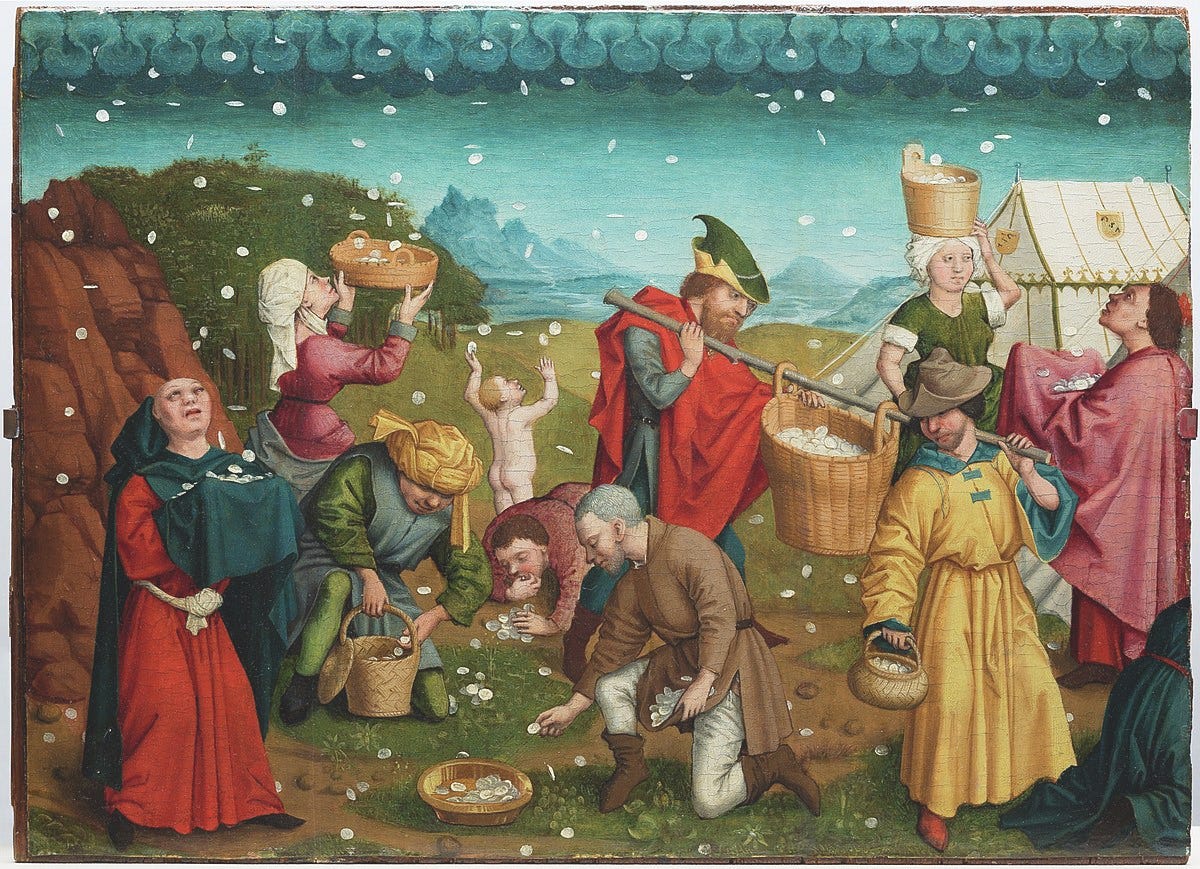
I’d be remiss if I didn’t note here the first use of bread, Hebrew lehem, in Scripture. It’s when God says to Adam, “In the sweat of your brow you shall eat bread.” Think of it: what looks like a curse shelters a great blessing. The Hebrews in their flight from Egypt begin to grouch, accusing Moses of bringing them out there to starve in the desert. Slavery and food would be better. Moses then prays to God, and he sends them the mah-nah, jocularly so named, as meaning, “What’s this?” It’s like pearly seeds covering the ground in the morning. When the Hebrews make paste out of it and bake it over a fire, it has a delicate and pleasant flavor, like wafers baked with honey. It is the lehem min-hashamayim, the bread from heaven. But that’s just a foreshadowing of the child who will be born in Beth-lehem, House of Bread, or as we might say, Breadville. Of himself he will later say, “I am the bread from heaven.”