


Have you ever been to a Greek Orthodox wedding? Or Greek Catholic, for that matter — or in most of the other eastern Churches? The high point of the ceremony comes when the bridegroom and the bride are crowned king and queen of their home-to-be, which is also their domestic church. Crowns are placed on their heads, with ribbons in back tied to one another, to suggest both dominion and unity. It isn’t a new thing. The ancient Roman pagans used to crown the married couple too, but then, as the tart Tertullian said, “the world crowns brothels, and baths, and bakehouses, and prisons, and schools, and the very amphitheatres, and the chambers where the clothes are stripped from dead gladiators.” That’s the Tertullian who asked, with asperity, “What does Athens have to do with Jerusalem?” But his was the minority opinion in that way. Whatever in the world is good by nature — and the idea of a king — our Word of the Week — is good, no matter how badly human beings can tarnish it or turn it inside-out, the faith can embrace, cleanse, elevate, and transform.
Debbie and I weren’t crowned when we got married — oh, now she reminds me that she did have a crown of orchids on her head! I suppose I might have felt a little conspicuous, not having been accustomed to the tradition. But if you think about it, it’s in keeping with the old saying, “A man’s home is his castle,” which meant also that “a woman’s home is her castle,” since the truth of it has to do with the sacredness of the home, a small society unto itself, with its own laws and traditions. As long as no one there is violating the law of the land, that place is its own. And if real human diversity is to be cherished, it seems to me that the kingdom of the home is essential to it. Imagine that every time you enter somebody’s home, it’s as if you have been given a passport into another land. That’s not so crazy, is it? And it is delightful, too.
The strongest argument against kings, I guess, is that nobody is to be trusted with such power, and no doubt kings have not always comported themselves very well. Yet the ideal is close to the human heart. I think of the saintly King Louis IX of France, sitting in the shade of an oak tree on the outskirts of Paris, available to any person of any rank or station, who wished to appeal to him directly for justice. He did that regularly. His advice to his son, the future Philip III, is golden. Or I should say that it is truly kingly, almost as if the legendary Arthur of the Round Table had come to life. It is a blend of strength and humility, personal care for the people, scrupulous honesty, and genuine kindness. Typical is the advice he gives Philip when a poor man contends with a rich man: “Sustain the poor rather than the rich, until the truth is made clear, and then do justice to them.” This also, concerning where the real strength of a kingdom lies: “Preserve [your towns and cities] in the estate and the liberty in which your predecessors kept them, and if there be anything to amend, amend and preserve their favor and their love. For it is by the strength and the riches of your good cities and your good towns that the native and the foreigner, especially your peers and your barons, are deterred from doing ill to you.”
You see, in the Middle Ages there was no idea of some all-encompassing “divine right of kings.” Louis was guided and curbed by the law of God and the Church, and more than that, like other kings of his time, he knew that even if it was only for self-interest, he had to foster and to protect the liberties of his cities and towns, and of other “chartered” bodies such as the universities. They had common rivals — ambitious or rapacious lords among the landed gentry. That was the typical flanking action for a medieval king, to unite with the townsmen.
But there I am talking politics — when the appeal of a king like Louis is something different. It’s the idea of law and fatherly protection and care, embodied in a person who is himself under law, not in an institution, certainly not in a tangle of bureaucratic regulations. Sure, I’m quite aware of what bad people can do to a thing that is naturally good, and the better it is, the worse it becomes when it goes bad. But I think it’s a lot harder to explain to a child what a premier is, or a president, than a king. By nature, we grasp what a king is. Our good friend the Lion in The Wizard of Oz is not the president of the forest!
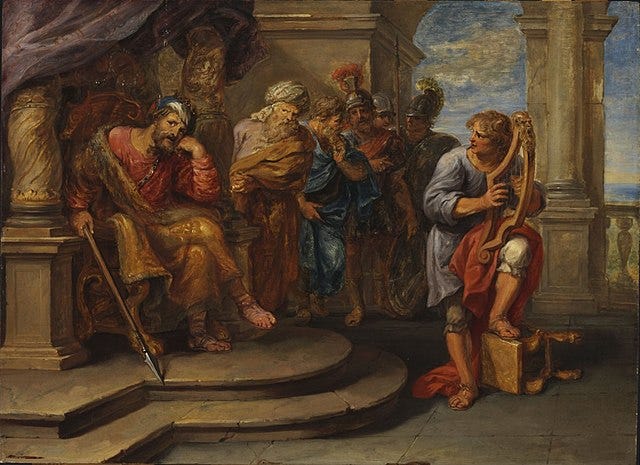
Scripture isn’t all that enamored of kings. The most common judgment we read is such as this: “And Ahab did what was evil in the sight of the Lord.” When the people first demand a king so that they can be like the nations roundabout, the judge and prophet Samuel blames them for it, and foretells the hardships they are calling down upon themselves. Nevertheless, he does anoint David — the beloved; and the Messiah, the great and ultimate king, is to come from David’s line. The Jews looked forward with longing to that future King; and it’s not by accident that J. R. R. Tolkien named the climactic book of his epic trilogy, The Return of the King. Nothing shabby or low-down, nothing like the sly senator Silas Ratcliffe in Henry Adams’ novel Democracy, or the American jobbers and confidence men in Charles Dickens’ Martin Chuzzlewit, but a real king, honest, brave, self-sacrificing, and pure. Tolkien intended his Aragorn to be a human and legendary shadow of the true King whose return Christians await.
The word king is a deeply personal one, too. It comes from Old English cyning, a verbal noun built from cynn, kin: as if the ruler is a “kinning,” someone who unites all the kin. Such a cyning, among the prehistoric German peoples, was like a chief of an Indian tribe, where everybody is thought to be related to everybody else. Our word has cousins everywhere across the Indo-European map, in words having to do with natural generation: Latin genus, kind; Greek genos, people, tribe; Sanskrit janati, to give birth; Old Irish gniid, to make; and many, many more. But there’s also, from early Latin gnasci, to be born, such words as natal and nativity, after the g was lost before the n (for the same phenomenon, think of English gnaw) — and the French word, with loss of intervocalic t, Noel. Which is what we are now preparing for, aren’t we?
Note: Our full archive of over 1,000 posts, videos, audios is available on demand to paid subscribers only. We know that not everyone has time every day for a read and a listen. So we have built the archive with you all in mind. Please do browse, and please do share posts that you like with others.


