


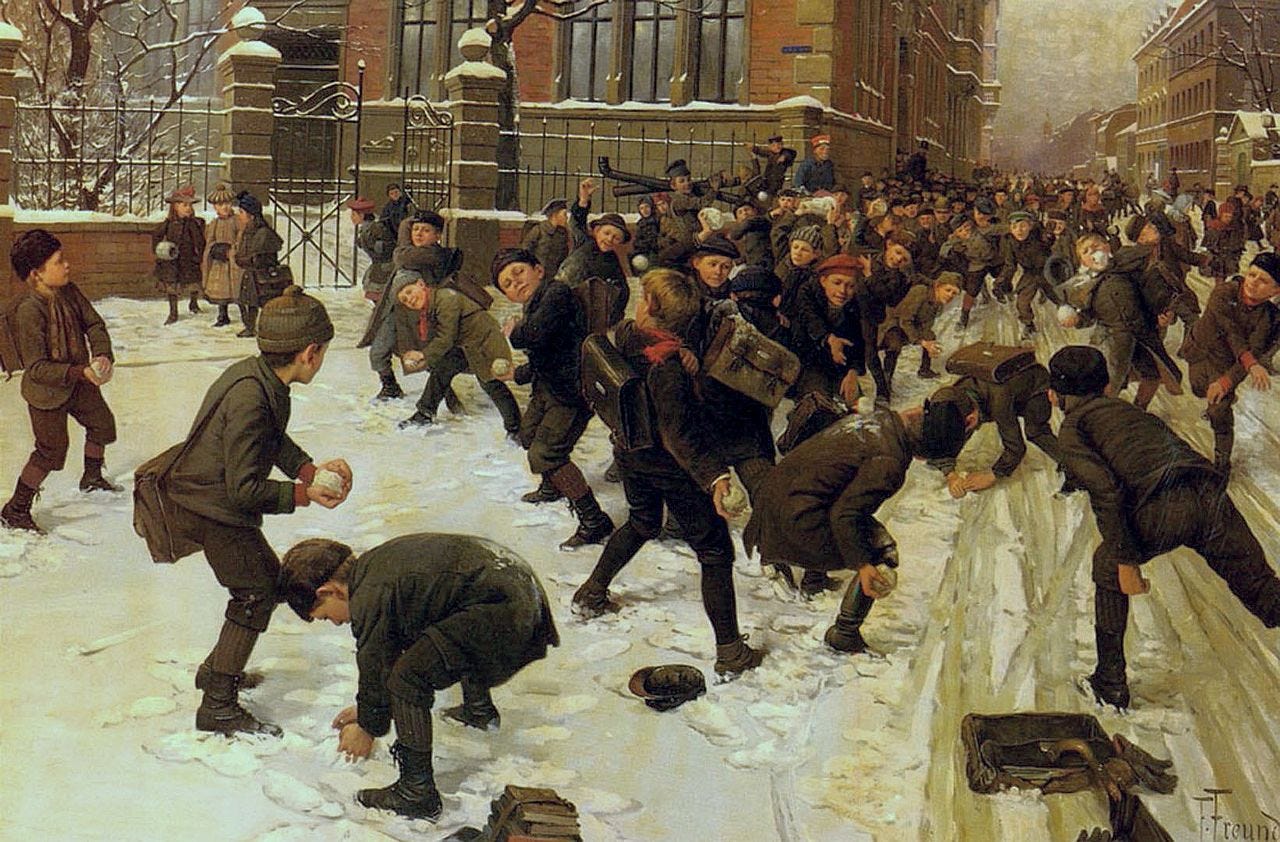
“A hundred thousand pairs of boys’ eyes are stealing anxious glances toward school windows today, lest the storm cease before they are let out, and scant attention is paid to the morning’s lessons, I will warrant. Who would exchange the bob-sled and the slide,” — and there’s our Word of the Week — “and the hurricane delights of coasting for eternal summer and magnolias in January? Not I, for one — not yet,” wrote Jacob Riis, that stalwart reformer and promoter of city life, all the way back in 1900. “Misery enough I have seen in New York’s tenements,” he says, but the spirit of the great city, when winter struck, came out in its youthful force. In snowball fights, for instance, really snowball wars between one block and another, which Riis describes with his usual eye for detail and his own boyish delight in action, and after all, he says, “there are worse things in the world than to let the boys have a fling where no greater harm can befall than a bruised eye or a strained thumb.”
Wisdom, that! In that winter of 1899-1900, Riis says that more than 1,300,000 cubic feet of snow were removed from the streets by the city and dumped into the river, and still people complained that it wasn’t enough. But snow and ice were meant for fun. Snowmen everywhere, and then, when frost and ice succeeded after the snow, they “paved the way for coasting in the hilly streets, and discovered countless ‘slides’ in those that were flat, to the huge delight of the small boy and the discomfiture of his unsuspecting elders.” A little boy — a stretch of ice — does it take a genius to tell what’s going to happen next? “With all the sedateness of my fifty years,” says Riis, “I confess that I cannot to this day resist a ‘slide’ in a tenement street, with its unending string of boys and girls going down it with mighty whoops. I am bound to join in, spectacles, umbrella, and all, at the risk of literally going down in a heap with the lot.”
And they slipped and slid and made merry with skates and sleds, too. “The coasting!” cries Riis in admiration and delight. “Let anyone who wishes to see real democratic New York at play take a trip on such a night through the uptown streets that dip east and west into the great arteries of traffic, and watch the sights there when young America is in its glory.” What do the policemen do? Except at railway crossings, Riis says, “they discreetly close an eye, or look the other way.” And now, what do I hear of in our time, but children forbidden to run in the playground during what short and stingy recess they are granted during the school day? It is winter here in New Hampshire, and we have had snow on the ground for a month and a half, and I’ve neither seen nor heard children sledding or sliding or skating — in snow, what I always thought was the finest plaything in the world. Even our old dog Jasper loved the snow, partly because of his silky long hair — he had no undercoat of fur — that didn’t hold the water.
I’m going to end with the last paragraph in Riis’ wonderful article, but first, I’ve got to say something interesting about the word. Those of you who know Latin or Greek may consider that there aren’t any words in those languages that begin with sl-, but there are all kinds of words in the Germanic and the Slavic languages that do, and in other of our big family of languages likewise. When that happens, historical linguists say, “Aha! Something is hiding those words!” And sure enough, in Latin and in Greek, separately, the initial s- was lost, as also in words that began with sm- and sn-: so we’ve got English snow, but its cousin in Latin is nix, and we’ve got English smile, but Latin mirari, to gaze at, to wonder. So we’ve got a lot of slippery words in English, all cousins, having to do with what you do on the ice, whether on purpose or not, and other words that have to do with slipping: slip, slide, sleek, slump, slouch, slush, slime, slumber, and so on. If they have relations in Latin, they will begin only with l: lubricus, “slippery,” languere, “to slouch,” limus, “mud,” linere, “to smear.” Why, there’s even that little critter that leaves a slippery trail: limax, “slug.” That doesn’t mean that all Latin words beginning with L correspond to English words beginning with SL. Most of the time, there wasn’t an initial S to lose in the first place. You see, the historical linguist is a bit of a detective, gathering evidence and tracking the changes as they happened.
But here are Riis’ last few sentences, as I promised. Consider, if you were an archaeologist ten thousand years from now, rummaging about the ruins of our world, the number of reasons you could bring forth to say, “These words could not have been written after 1950.”
The great city lying silent under its soft white blanket at night, with its myriad of lights twinkling and rivaling the stars, is beautiful beyond compare. Go watch the moonlight on forest and lake in the park, when the last straggler has gone and the tramp of the lonely policeman’s horse has died away under the hill; listen to the whisper of the trees, all shining with the dew of Boreas’s breath, of the dreams they dream in their long sleep, of the dawn that is coming, the warm sunlight of spring, and say that life is not worth living in America’s metropolis, even in winter, whatever the price of coal, and I shall tell you that you are fit for nothing but treason, stratagem, and spoils; for you have no music in your soul.
Word & Song by Anthony Esolen is an online magazine devoted to reclaiming the good, the beautiful, and the true. We publish six essays each week, on words, classic hymn, poems, films, and popular songs, as well a weekly podcast, alternately Poetry Aloud or Anthony Esolen Speaks. Subscribe below.

We think of our Word & Song archive as a little treasure trove. Our paid subscribers have on demand access to the entire of Word & Song, many hundreds of entries. For everyone else, there’s always plenty to see here, as well. We hope that all of our readers will revisit and share our posts with others as we continue our mission of reclaiming — one thing at a time — the good, the beautiful, and the true.


