

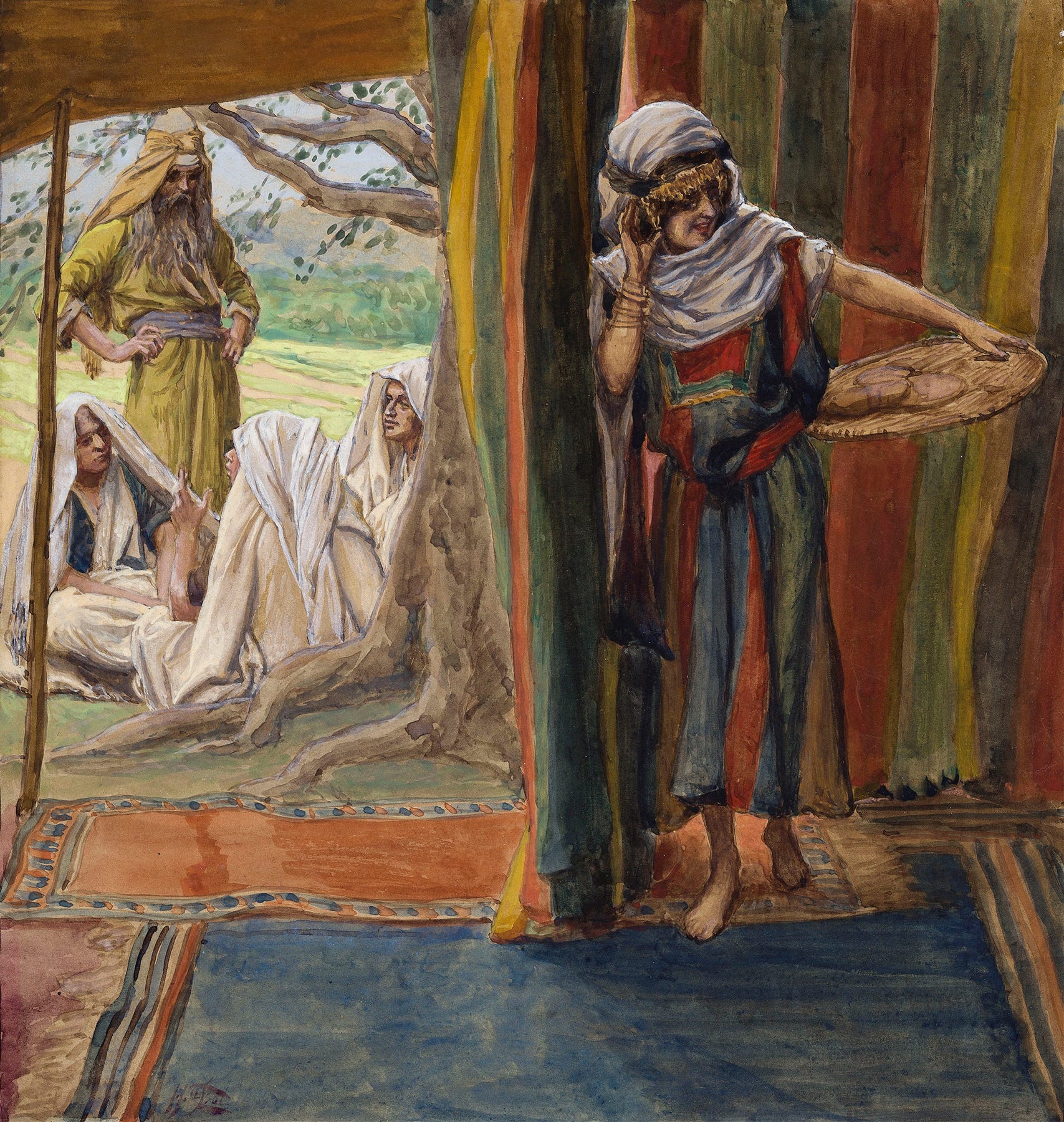
Today — Sunday, as I write this — our priest showed us a beautiful gilt icon with Andrei Rublev’s painting of the Trinity in the center. You may know the icon. It’s actually the three young men — and there’s our Word of the Week, three — or rather the three angels who visited Abraham by the oaks of Mamre and foretold to him the birth, one year hence, of a son. Sarah his wife overheard it, and, since she and Abraham were old, she giggled — perhaps thinking of the preliminaries. The young man who did the speaking overheard her, though Sarah tried to deny it, and her giggling would end up being the source of the boy’s name, Yitzhak, from the verb to laugh. In any case, Christians have long looked upon the three angels as a manifestation of the Trinity, and Rublev has that in mind. Over the head of the Father, seated on the left, is Abraham’s house. That alludes to Jesus’ saying, “In my Father’s house there are many mansions,” the house being heaven itself, not the skies above our heads, but that transcendent creation wherein all the blessed dwell. Over the head of the Son, seated in the center, is a big flourishing tree — the oak tree of Mamre, but also the Tree of Life, which is the Cross. Over the head of the Spirit, seated to the right and looking down in humble silence, is a mountain. Many are the mountains in Scripture, where someone is led by the Spirit to climb: Abraham on Moriah, Moses on Sinai, but most important of all, Jesus on Tabor, the mountain of the transfiguration, on Calvary, and on Bethany, the mountain of the ascension.
“Three’s a crowd,” you’ve heard people say, but that’s only when you’ve got a man and a woman in love and they want to be alone. For it isn’t really a community unless you have three. If the three are man, woman, and child, you have suddenly a web of relationships. The father loves the mother all the more for her loving his child, and he loves her love for the child, and the same goes for the mother, and the child, loving the mother and father, loves also the love he sees between them. God is himself a communion of relationships of love, the Father who is the originator, the only-begotten Son, and the Spirit that is the love between them, himself a person also. In the three, all the infinity of relation is comprehended. God is not, to use Chesterton’s telling phrase, “the lonely God of Omar,” that wonderful but sad Muslim poet and mathematician. Omar wrote a lot about love and drinking wine, but he did not know that God himself, aside from all creation, is Love.
Three is an important number, isn’t it? If “one is no number,” as people in the Renaissance used to say, then 3 is the first odd number. It’s the first prime number after 2. There are three times, we say, past, present, and future. We perceive three physical dimensions, length, breadth, and height. We use triangulation to pinpoint the source of a signal. Trigonometry used to take up a whole year of high school math: the study of triangles. You can tile a floor with triangles of the same shape and size, regardless of what the angles are. The number 3 is also convenient for us, given the way we conceive our integers. Since it’s a factor of 9, you can tell if any number is divisible by 3 by adding all the digits. If the sum is divisible by 3, then so is the original number. When you do it, you can mentally skip over all the 3’s, 6’s, 9’s, 12’s, and so on, so that you can look at something monstrous, like 359120611, and ignore the 3, the 9, the 12, and the 6, and what’s left is just 5 + 1 + 1, or really just 1. So when you divide it by 3, the remainder will be 1. It’s because we write our numbers out in base 10, so that 9 and its factor 3 will have that property. If our base were 13, then you’d find the same property in 12 and factors of 12: 2, 3, 4, and 6. Try it — or have your older kids try it!
You can describe, with mathematical precision, the motions of two bodies orbiting each other, if you have their mass, their initial position, and their momentum. But if you add a third body, all bets are off. There are no general solutions, and even tiny differences in the initial conditions can produce widely divergent and unpredictable results. That’s the so-called “three body problem,” that Isaac Newton first wondered about, after the apple hit him in the bean.
How about the word, three? It’s one of the most reliable of all the number-words in our big Indo-European family: Latin tres, Welsh tri, Russian tri, Sanskrit trayah, Albanian tre, Hittite tere, and so on. Hittite? Sure! It is one of our kin. It’s pleasant to consider that the native tongue of Uriah the Hittite was related to English of all things, and not to Hebrew. We also have our word thirty, originally meaning three tens, and our word thirteen, meaning three and ten. But we once had a delightful word for that unlucky number 13. Just as eleven meant one-left, that is, one left over after you knock ten off, and twelve meant two-left, so we had Old English threolf, which would now be threlve, meaning three-left. I like that word, don’t you? Just as I like another word we might have kept, for the number 110, from Old English enleofantig, meaning eleven tens, or — and fans of Tolkien’s The Hobbit will like this one — eleventy!

Word & Song is an online magazine devoted to reclaiming the good, the beautiful, and the true. To support this work, please join us as a subscriber.
We think of our archive as a little treasure trove. Our paid subscribers have on demand access to the entire of Word & Song, many hundreds of entries. For everyone else, there’s always plenty to see here, as well. We hope that all of our readers will revisit and share our posts with others as we continue our mission of reclaiming — one thing at a time — the good, the beautiful, and the true.


