

“How can we invite Tom to our parties now?” said Virginia Woolf, once she heard that Tom had become a member of the Anglican Church, rather than one of the fashionable atheists that made up their set at Bloomsbury. She really was dismayed by it. Perhaps she had not been reading Tom’s poems closely enough, because that young man was always yearning in his heart for the solid reality of God, as opposed to the flyaway dreams and nightmares of hedonism. For those are the two fundamental options. “If the dead are not raised,” says Saint Paul, quoting the prophet Isaiah, “let us eat and drink, for tomorrow we die.” That is what he says to those Greeks at Corinth who were diluting the good news, the good spell. I take it that the Corinthians were ready to believe in the immortality of the soul, sort of, but not in the resurrection of the flesh and thus eternal life for the individual person: in the real, genuine raising of each human being from the dead.
So when Virginia Woolf heard the news that T. S. Eliot had accepted the only real news that mankind has ever heard, she blanched. There’s something ambiguous about this notion that newspapers bring the news. If we mean that they tell us what happened yesterday, sure, they do that. If we mean that what happened yesterday is something quite different from what happened the day before yesterday, or a hundred or a thousand years ago, we have to hedge. It may be Saddam Hussein today, Louis XVI yesterday, and Charles I the day before. It may be Watts today, Haymarket yesterday, and George Gordon in London the day before, whose sympathizers looted and burned, set open Newgate Prison, and sacked the Bank of England. You can read about it in Dickens’ novel, Barnaby Rudge. As the wry and sour Preacher puts it, “What has been is what will be, and what has been done is what will be done; and there is nothing new under the sun.”
So, in the short poem that we’re looking at this week, T. S. Eliot suggests to us, with a sad and satirical air, that there’s something rather pathetic about waiting for an evening newspaper, The Boston Evening Transcript. We get that sense from his sure touch with anticlimax, building up to what ought to be something great, and then all you get is a newspaper, whose name is repeated three times — as if it were not mundane enough to name it only once. You may think that the poem is written in free verse, but it isn’t really. About half of the lines are iambic pentameter; others have those five strong beats, but not strictly iambic, and two of them, the final line and the antepenultimate line, sort of deliberately fall out of meter, languidly, exhaustedly, “wearily,” as Eliot himself says.
The scene itself is gently surreal, too. Who’d have thought to compare the readers of a newspaper to a field of ripe corn, swaying in the wind? The corn is beautiful, but the readers aren’t. The corn is natural, but the readers, I think, aren’t. It’s disappointing. So when the speaker of the poem is about to go back in the house, he turns toward the street, as if he were to say goodbye to Rochefoucauld. That would be Francois, duke de la Rochefoucauld (1613-1680), whose Maxims are shrewd observations, usually on the sadder side of human nature. He doesn’t see the whole truth, but he never pretended to, and what he does see, he expresses with extroardinary conciseness and wit. “The same pride that makes us condemn faults we believe ourselves free of leads us to misprize good qualities we do not have.” “Virtues lose themselves in self-interest, as rivers lose themselves in the sea.” “It is far easier to be wise for other people than for oneself.” Imagine if The Boston Evening Transcript were full of such observations. Who would need to read the political pages? You could go straight from Rochefoucauld to the comics, where you might get the same sort of thing from Al Capp or Bill Watterson.
One more thing about The Boston Evening Transcript, which ceased publication in 1941, after more than a century in operation. Maybe Eliot was glancing at it too, or thought his readers in the Boston area would be aware of it. It’s that the Transcript regularly published genealogies, and the Eliots, though Tom’s father had moved to Saint Louis, were Boston Brahmins of an exalted order, and the post-war degeneration of European aristocracy is a recurrent theme in Eliot’s poetry. Now, when I was a boy, I liked newspapers a great deal, but — I confess — we haven’t subscribed to one in 30 years. I love poring over very old newspapers, as if they were time capsules, and I always find something fascinating to hold my attention. But those are gone. The sun rises, and the sun sets. What else do we expect from what Pope Leo XIII called the ephemeri: the dailies? But the true good news is that there really was something new, then and now and ever new. T. S. Eliot didn’t find it in The Boston Evening Transcript. He found it in the men whose bylines were Matthew, Mark, Luke, and John.
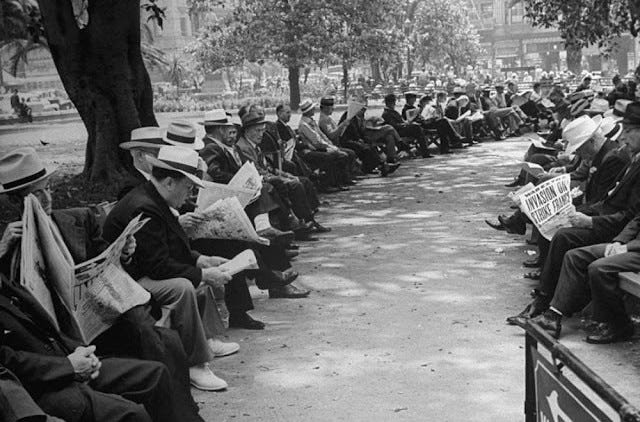
The readers of the Boston Evening Transcript
Sway in the wind like a field of ripe corn.

   When evening quickens faintly in the street,
Wakening the appetites of life in some
And to others bringing the Boston Evening Transcript,
I mount the steps and ring the bell, turning

Wearily, as one would turn to nod good-bye to Rochefoucauld,
If the street were time and he at the end of the street,
And I say, "Cousin Harriet, here is the Boston Evening Transcript."
Word & Song by Anthony Esolen is an online magazine devoted to reclaiming the good, the beautiful, and the true. We publish six essays each week, on words, classic hymn, poems, films, and popular songs, as well a weekly podcast, alternately Poetry Aloud or Anthony Esolen Speaks. Subscribe below.

We think of our Word & Song archive as a little treasure trove. Our paid subscribers have on demand access to the entire of Word & Song, many hundreds of entries. For everyone else, there’s always plenty to see here, as well. We hope that all of our readers will revisit and share our posts with others as we continue our mission of reclaiming — one thing at a time — the good, the beautiful, and the true.


