


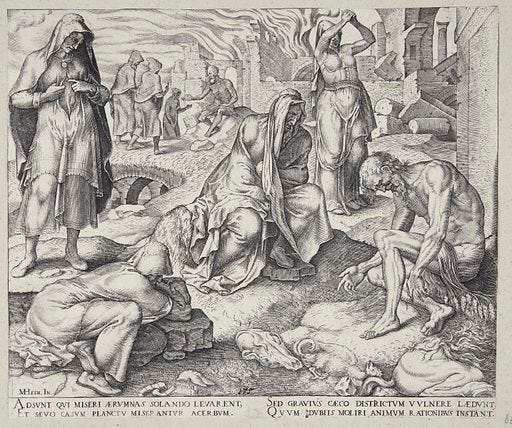
“Were you there when I laid the foundation of the earth?” asks God, confronting Job out of the whirlwind. “Have you commanded the morning since your days began?” It is a long series of questions that remind Job, again and again, of two things. The first and more prominent is that God is the Lord of all things, the transcendent, the creator, all-wise, all-powerful. The second and less prominent, but more dramatically to the point, is that God cares for all his creatures, from the greatest to the smallest: “Who provides for the raven its prey, when its young ones cry to God?” The ostrich “leaves her eggs to the earth, and lets them be warmed on the ground, forgetting that a foot may crush them.” She has no understanding; yet we are to understand that God cares for her young, even if she does not. After Job hears all this, he does not say that he now knows why God has permitted such calamities to befall him and his family. That knowledge is still folded up in the secrecy of God. But he does trust God, he bows his head before him, and says, “I had heard of thee by the hearing of the ear, but now my eye sees thee; therefore I despise myself, and repent in dust and ashes.” And there is our Word of the Week, ashes. It’s actually a near doublet, with a very fine and unexpected play on the sounds: ‘al ‘aphar w’ ’epher. The first one, the ‘aphar, is what the serpent who tempted Adam and Eve is going to eat all the days of his life: dust. It’s what the Lord calls Adam at the end of his judgment: “For dust thou art, and shall to dust return.”
The second word, the ashes, is not related to the word for dust, for all that they sound similar. For one thing, ‘aphar begins with a glottal stop, very hard for us English speakers to pronounce at the beginning of a word; that’s what is signified by the transcription with the backwards and upside-down apostrophe. If you want to hear a glottal stop, just say the word bottle as a Cockney would say it, gulping down the t’s: baw-‘ul. But ashes were, like dust, also a sign of humiliation or worthlessness. “Your sayings are proverbs of ashes,” says Job to one of his annoying friends, Zophar. They could also be a sign of self-humiliation, as with Job himself, or as with the King of Nineveh, who, when he heard the prophecy of Jonah, that Nineveh would be destroyed, repented in sackcloth and ashes.
What’s the difference between dust and ashes? In American English, the word dust refers only to what is light and dry and insubstantial, as when overtilling and exhaustion of the soil led to the calamity of the Dust Bowl in Oklahoma and southern Kansas, which led to the migration of farmers to California, so memorably captured in Steinbeck’s novel, The Grapes of Wrath. But ash or ashes must be what’s left after you’ve burned something down to dust. You can have dust without a fire, but not ash. By the way, the tree we call the ash has nothing to do with the ashes left in the furnace. They’re just two words that happen to sound alike. In Old English, each was spelled æsc, with that first character that looks like an a and an e squashed together. Well done, too, that character, because the vowel we pronounce in the word ash really is between ah and eh. Try it — notice where your tongue goes when you say loss, lass, less.
Anyway, today’s word ash comes from an Indo-European root, as-, having to do with burning. Here’s a tip for any of our readers who might be teaching their kids Latin. Have you noticed sometimes how an s turns into an r as you go from the nominative to the other cases? What happened is that an s pronounced between two vowels, actually pronounced like a z in prehistoric Latin, a buzzing sound, turned into the buzzing sound of a trilled r. Sure, it’s hard for us English speakers now to hear the similarity, but so it happened. The noun is tempus, with an s, but when a vowel followed it, it turned into an r, as in the adjective temporalis. So in Latin, something that is as dry as ash is ar-idus, which gives us English arid: and yes, that r there was originally an s, and the word arid is a cousin of our word ash. The word combustion is also a cousin, but that would take a long time to explain.
When I was a little boy, I saw ashes all the time. We had a coal furnace, and every week my father shoveled out the ashes from inside, and put them in an ashcan for the town to pick up at the roadside. The ashes were gray and very soft, almost like talcum powder, and burning coal, at least the anthracite we had in our town, had a sharp clean smell to it, not unpleasant. But everybody had those ashcans. They were useful for quite a few things. Before we got a bathtub at our house, I took my baths in one of them — I was only 2 or 3, after all. But we’d also use them for bottled drinks and chipped ice when we went to the lake to spend the day, all 20 or so of us — Grandma and Grandpa and aunts and uncles and cousins.
Then of course there was ASH WEDNESDAY, sometimes called in Middle English “PULVER WEDNESDAY.” Everybody in our Catholic school went to Mass that morning and got the ashes marked on our foreheads. You’d see them on plenty of people in town, too. The tradition of a period of fasting for the 40 days before Easter comes from the early 300’s at the latest, and then Pope Gregory the Great set the period as 46 days, culminating in Easter, the 47th day. The idea is that you don’t fast on Sunday, and there are six Sundays in that period. So that means that if Easter is day 47, Ash Wednesday will be day 1 — count them. And while we’re counting, let us hear the words, “Remember, Man, that thou art dust, and unto dust thou shalt return.”
Word & Song by Anthony Esolen is an online magazine devoted to reclaiming the good, the beautiful, and the true. We publish six essays each week, on words, classic hymn, poems, films, and popular songs, as well a weekly podcast, alternately Poetry Aloud or Anthony Esolen Speaks. Subscribe below.

We think of our Word & Song archive as a little treasure trove. Our paid subscribers have on demand access to the entire of Word & Song, many hundreds of entries. For everyone else, there’s always plenty to see here, as well. We hope that all of our readers will revisit and share our posts with others as we continue our mission of reclaiming — one thing at a time — the good, the beautiful, and the true.


