


Young David Copperfield has just offered to teach the older fellow next to him some of the things he’s learning in a well-run boys’ school in Canterbury. The older fellow, Uriah Heep, is freckled and oily, always rubbing his hands, rather like a praying mantis, as I imagine him. He’s eaten up with ambition, but he pursues it in a low-down way — in a humble way, as he supposes, and as he wants people to believe. He’s also got a Cockney 'abit of dropping his H’s off the ’ead of that word, so 'ere’s 'is reply:
"Oh, indeed you must excuse me, Master Copperfield! I am greatly obliged, and I should like it of all things, I assure you; but I am far too umble. There are people enough to tread on me in my lowly state, without my doing outrage to their feelings by possessing learning. Learning ain’t for me. A person like myself had better not aspire. If he is to get on in life, he must get on umbly, Master Copperfield.”
For our Word of the Week this time, we’ve got our special feature, “What’s in a Name?”, and the phrase I have in mind is humble pie, which Uriah is going to have to eat some of, by the time this novel is finished. For Uriah is not humble but unctuous, not lowly but mean, not self-effacing but self-promoting by sly and underhand plotting. It’ll be prison for you, Uriah!
But dear Reader, what if I told you that the phrase humble pie originally had nothing to do with humility, and that Uriah’s ’abit of dropping the H’s off the word ’umble can show us why?
So I’ll take you to another scene — this time it’s a jolly deer hunt in the dead of winter, and the lord of the manor and his men have had great luck hunting deer. The poet — we’re in the middle of the splendid Sir Gawain and the Green Knight, from the 1300’s — describes with gusto the flaying and butchering of the biggest of the deer right on the spot. It takes about 20 lines, beginning with “slitting the slot,” which is the cleft that divides the breast, and they end with the back parts. Here’s Tolkien’s translation of the part I’ve got in mind:
Thus by the bones of the back they broke off with skill,
down even to the haunch, all that hung there together,
and hoisted it up all whole and hewed it off there:
and that they took for the numbles, as I trow is their name.
Numbles! That comes from the Middle French word nombles, referring in a broad sense, if you were talking about hunting or cookery, to the loins of an animal; specifically, in a deer, to the fatty region between the thighs. That wasn’t the best part, but people did use it. In a pig, it seems to have referred to the chine, along the ridge of the back, and at the church of Sainte-Croix, in the village of Vasles in 1393, it’s recorded that the Feast of All Saints was celebrated with a feast of pork numbles. In Middle French it might also refer, in human beings, to what we always keep covered unless we’re in the bathtub. So Marco Polo — in a French translation — records this encounter, which I’ll render into modern English, except for the key word: “The other men asked them how come they went around naked, and weren’t ashamed to show their numbles, and they said it was because they came into this world naked and without any clothes.”
Well, in those days, you didn’t want to waste any part of an animal, so the numbles, which weren’t so good to serve up by themselves, would be minced and heavily spiced, and that is where we in English got the phrase numble pie! I said that the phrase had nothing to do, historically, with the word humble: French nombles came from late Latin lumulus or lumbulus, the diminutive of lumbo, loin. If you ask me how lumulus with an L became nombles with an N, I can only guess that something similar happened in French to what happened in English, except that it went in the opposite direction, sticking an N where it didn’t belong, as opposed to taking an N away where it did belong.
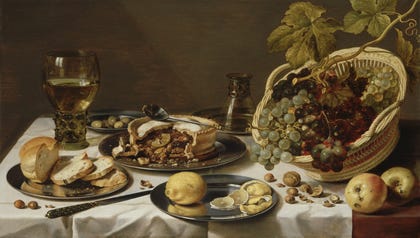
It’s what is called faulty separation. Say, real fast, again and again, “A numble pie, a numble pie, a numble pie!” Don’t you find yourself on the verge of saying “An umble pie”? And the H in the word humble was, in English dialects, either silent (as in honor), or sometimes pronounced and sometimes not, depending on where you were (as in homage or ‘omage), or just lightly pronouced as H’s are (as in history). So it’s easy to hear how you could get from a numble pie to an umble pie (as you pronounce it), which would be printed as an humble pie, or simply humble pie. To eat humble pie means that you eat something that sure isn’t filet mignon. And now it means, to change the metaphor, that you have to swallow your pride, or, to change the dish, that you have to eat crow. Why crow? Because crow, apparently, doesn’t taste very good.
By the way, I’ve talked before about this oddball mistake that produces a funny new way of saying something old: see the discussion for the word tawdry. It’s how we got the words nickname, adder, newt, orange, uncle, and apron, depending on whether the N from the word an got stuck onto the following word beginning with a vowel, or whether the N that began a word got detached from it and turned the previous article a into an. If you’ve ever seen the film Lawrence of Arabia, you can hear the Arab youths doing the same thing to the L on his name, hearing it as al-Awrence, so they call him Awrence. Somehow that doesn’t ring right, does it — Awrence of Arabia?
Word & Song by Anthony Esolen is an online magazine devoted to reclaiming the good, the beautiful, and the true. We publish six essays each week, on words, classic hymn, poems, films, and popular songs, as well a weekly podcast, alternately Poetry Aloud or Anthony Esolen Speaks. Subscribe below.

We think of our Word & Song archive as a little treasure trove. Our paid subscribers have on demand access to the entire of Word & Song, many hundreds of entries. For everyone else, there’s always plenty to see here, as well. We hope that all of our readers will revisit and share our posts with others as we continue our mission of reclaiming — one thing at a time — the good, the beautiful, and the true.


