


Dear Readers — we too at Word and Song are going to be celebrating the 250th anniversary of the founding of the United States of America, that is, the 250th anniversary of her Declaration of Independence, on July 4, 1776. I cheer every such celebration, in all countries throughout the world, and my heart stirs at the words of Sir Walter Scott:
Breathes there the man with soul so dead,
Who never to himself hath said,
"This is my own, my native land!"
It’s a part of the virtue of piety to foster such love, and to feel proper gratitude for all the unearned gifts which your native land has brought to you. I’m not talking about politics here. I mean the farm show and the fair, with rides and great food and the dunking machine. I mean the Little League baseball game in my home town, on a field perched a hundred or so feet above the river, with an acre of wild blueberries towards the setting sun, the chatter in the infield, and me, a teenager earning a little money by being the umpire behind home plate. I mean the drawl of the south and the boisterous mispronunciations of Brooklyn. I mean the common cheerfulness of a people with big broad skies and a confidence that ordinary people can accomplish great things.
I was traveling alone through Italy in 1985, making my way south toward my people’s paese in Calabria, a mountaintop village called Tiriolo, about ten times as old as the United States is. One evening I found myself in Assisi, eating supper at a restaurant. It was rather early, so the only other patron was a young fellow from Florence, a salesman on the road. He said it was silly for us to sit at separate tables without talking — Italians are like that. So we had supper together, and we got to talking about Italy and the paese. He confirmed what I’d suspected, that Italians don’t really feel a lot of affection for Italy, not so much as they feel for their region (Calabria, Tuscany, Sicily, and so on), and not nearly so much as they feel for their paese, which in his case was Florence. The paese isn’t a political thing. And it’s not just a town. It’s the locality, with the town or village at its heart. To be a paesano means that you come from that same paese. It’s what an Irishman might feel about Galway if he grew up there — Galway might be more real to him than Ireland is. We in the United States don’t feel quite the same way about the small place where we were born, and that’s a loss, for sure, but instead we claim a love for wherever in the country we have lived or traveled or visited, and we like to talk to people who live in places where we’ve never been, to ask them what it’s like — in International Falls in the winter, or Fairbanks in summer under the midnight sun, or the boggy lowlands around Houma, Louisiana, in the delta of the Mississippi. Forgive me, but — there’s got to be no place like Houma!
You see, I’m approaching, in a gingerly way, our Word of the Week, country. It isn’t exactly the same as nation, is it? It comes ultimately from a Late Latin phrase, terra contrata, denoting the land that stretches out before you; what we might call, if we were standing on a rise of land, the countryside. The phrase entered Old French as contree, and thence into Middle English with no real alteration. You’ve heard, no doubt, of the fable of the country mouse and the city mouse? It’s one of Aesop’s fables, picked up by Horace in one of his satires, in which the freedom and fresh air and safety of the country have it all over the wealthy but cramped and dangerous life in the city. It’s been part of our common English heritage for many centuries. Everybody’s told and retold the story, from the Tudor poet Thomas Wyatt to the cartoonists Hanna and Barbera, who sent the country mouse Jerry, itching to travel, to visit his cousin in the city, only to find out that he had things a lot better back home. Always the advantage goes to the country; at least, I don’t recall any exceptions. We like the country naturally, but we have to accustom ourselves to the city.
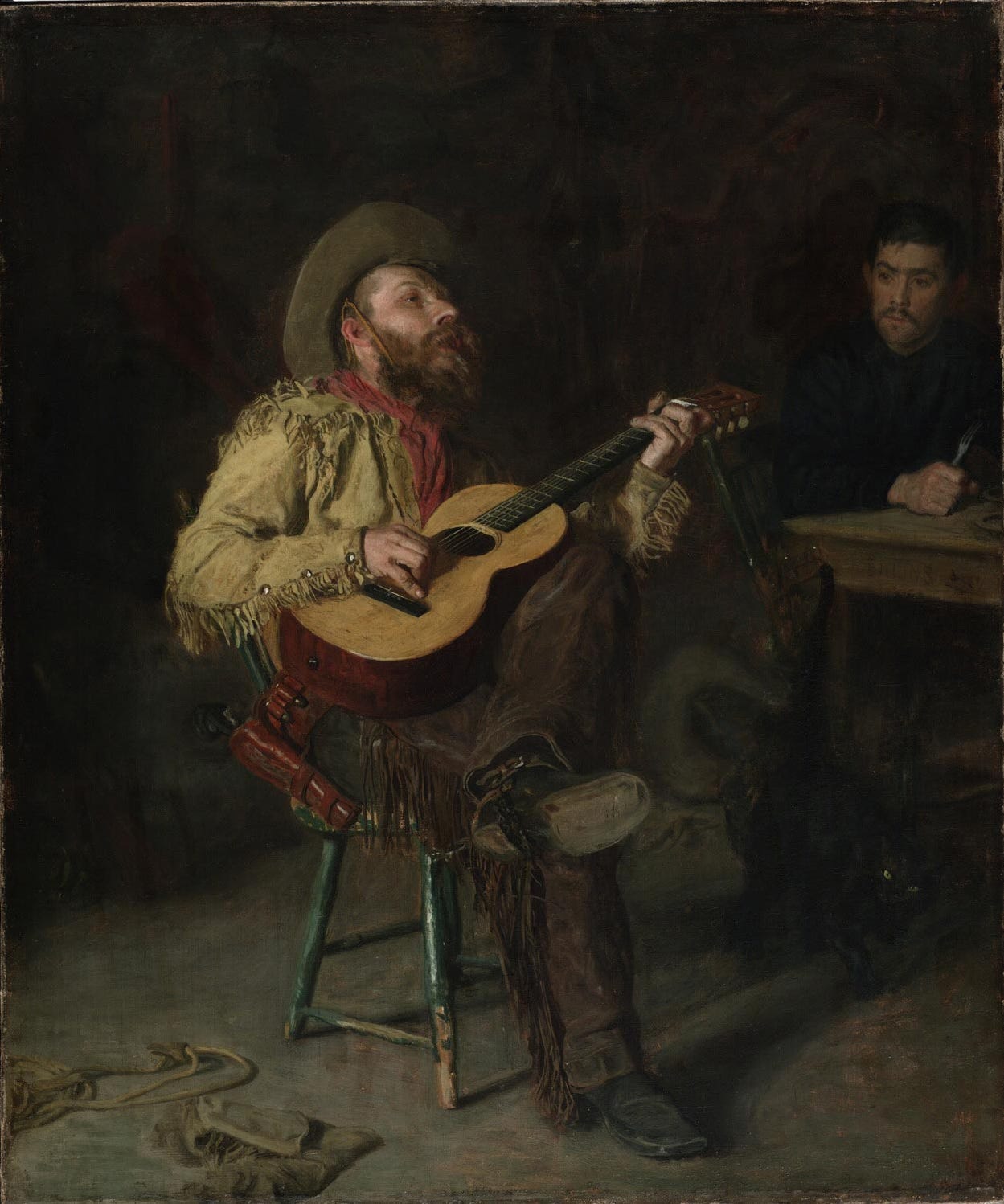
Or so it seems to me. At one of the World Cup matches in the United States last week, some seventy thousand fans took up the singing of John Denver’s song, “Country Roads.” One of my friends wondered whether it was now the only song — other than the national anthem perhaps — that every American could recognize and sing. That’s a shame, if so. We used to have songs celebrating city life too: “We’ll Take Manhattan,” “Chicago,” “East Side, West Side,” “Meet Me in Saint Louis.” But maybe, if you go into the country in the United States — notice the shift in meaning? — you will find people who can still sing, “Carry Me Back to Ol’ Virginny,” “Sweet Betsy from Pike,” “Big Rock Candy Mountain,” or even “The Arkansas Traveler.” Or if not those, then some of the best-loved “country music” hits (the phrase “country and western” dates only from 1948) — like Johnny Cash’s “I Walk the Line.” I fear that a people who don’t sing together cease to be a people.
But we should all get out into the country. My father, who sold insurance for Bankers’ Life and Casualty, loved the people of the countryside, and told me that farmers were the best, because they were friendly and welcoming, and if you treated them right, if you stood up for them when their claims were denied or when they were slow in getting processed, they would tell all their neighbors about you. There’s peace in the countryside, or there ought to be. When I am gathering blueberries or some other wild good thing in the woods or on a barren on our island in Canada, I am utterly at peace, and the world seems more real to me, more mysterious, and filled with goodness. It’s not hard to love the countryside. Whenever we were driving in the country nearby and we passed a dairy farm, my father would call out, “Ah, breathe that country air!” He must have learned it in Dad School. And my mother would poke him in the ribs and we kids would groan and laugh. But we loved it too.
We think of our archive as a little treasure trove. Our paid subscribers have on demand access to the entire of Word & Song, many hundreds of entries. For everyone else, there’s always plenty to see here, as well. We hope that all of our readers will revisit and share our posts with others as we continue our mission of reclaiming — one thing at a time — the good, the beautiful, and the true.


