

“Don’t make a show of yourself!” you may have heard one of your parents say when you were a kid, and you understood it right away, but if you think about it, show, our Word of the Week, is a tricky little word, and it’s a tribute to human intelligence that we don’t need a computer to tell us in what direction to take it. What I mean is this: show means either that you show something, with all the action on your part, or that somebody else is looking at you, regardless of whether you intend it. It’s like the word look: John can have a look in his eye, meaning that John is the one who’s looking, or Bob can say, “John sure has a funny look about him,” or even John’s car can have a funny look, and there it’s John or his car that we’re looking at. Maybe Sally hears about John’s car, and says, “That old Edsel is a steal!” meaning not that the Edsel stole John, but that John “stole” the Edsel by paying for it two bucks and a pack of baseball cards. And when we hear sentences like these, even, as I say, when we’re just little children, we don’t reason about them step by step. We know straight off what they mean. We see it. And there’s another one — sight! “What sharp sight,” you might have said about me when I was young, because I had 20-10 vision in my left eye, and 20-15 in my right, so that I often would read, upside-down, the newspaper my father was reading across from me at the breakfast table, and I’m not just talking about the headlines. But “What a sight!” you might have said that same day, if you saw me coming home from a ballgame, drenched with sweat, and with dirt stains on my knees and the seat of my pants. One meaning is active: I’m seeing. The other is passive: I’m being seen. Same word, opposite directions.
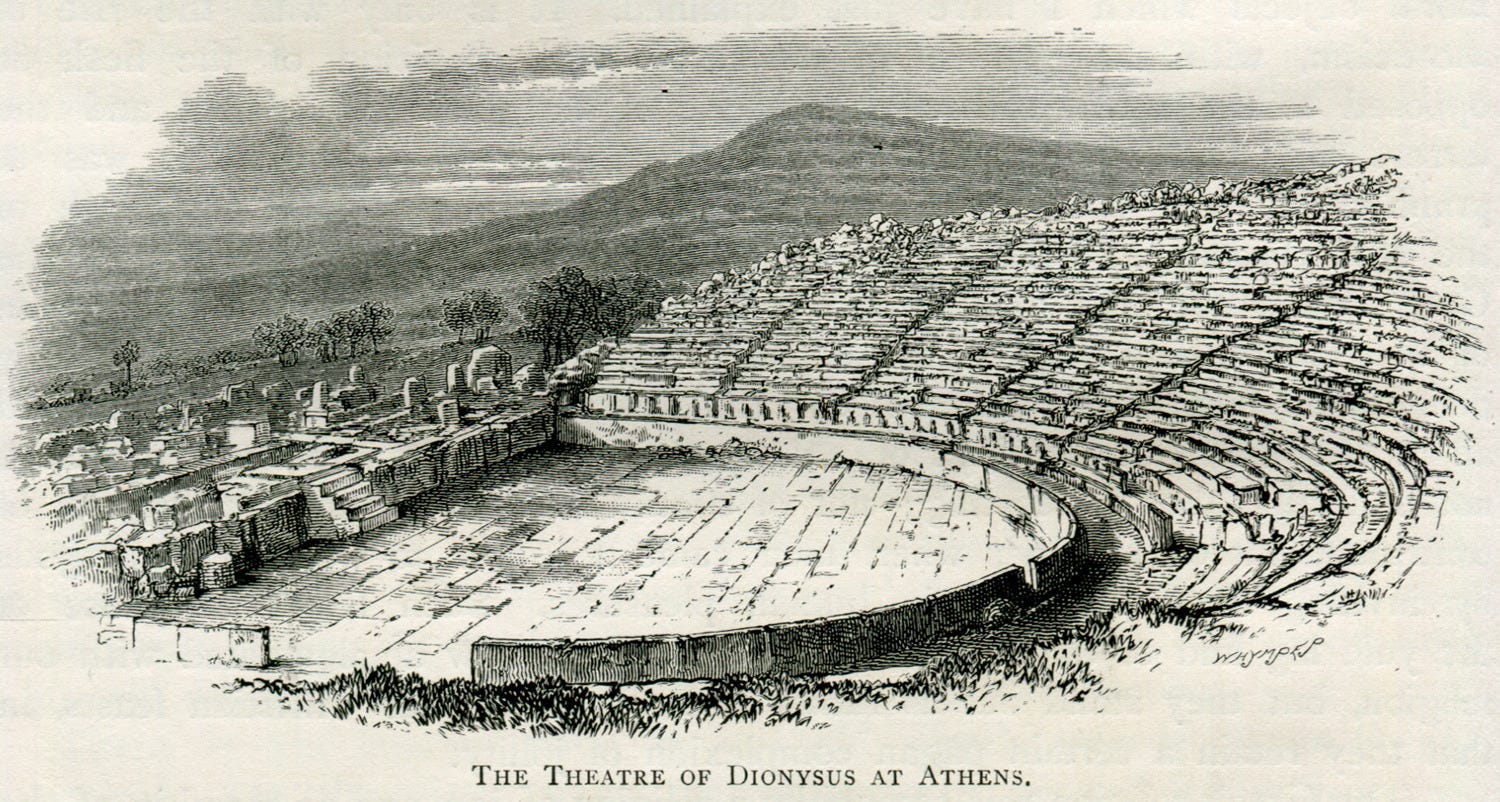
But why shouldn’t we make shows of ourselves? What’s wrong with being an actor? In ancient Greece, the land where western drama was invented, playwrights and actors were held in high regard. That’s because the drama wasn’t for idle entertainment. If you were in Athens in the year 401 B.C. for the great feast in honor of Dionysus, you might have gone to the vast outdoor amphitheater to see the play Oedipus at Colonus, Sophocles’ final play, staged posthumously by his grandson, also named Sophocles. It was part of the most important civic and religious festival in Athens, and if you were a foreign dignitary, you’d get a good seat, next to the greatest men in the city, and the sons of Athenian veterans who had died in the previous year. The actors had to play their parts by using the voice and a quite limited range of bodily actions and gestures — they held masks in front of their faces to let everybody know who was who. There couldn’t be any scene-stealing, not really, and the particular personality of the actor was not in play.

But as soon as you’re on stage now, you’re aware that everybody is looking at you, and that’s a temptation. We’ve seen actors hamming it up, right? And actors can be remarkably touchy about being seen to their best effect. I remember here a story I read once about the elegant and highly temperamental actress Tallulah Bankhead, who did most of her work on stage rather than before the camera. A young actress in a play had “upstaged” her, and Tallulah was furious. “Dahling,” she said, with her Southern drawl, and her cigarette-voice sinking below alto, “I can upstage you without even being on the boards.” The young actress was a snip, so she just laughed. But the next night, just before the snip’s big scene, Tallulah was on stage drinking a glass of water, and before she exited, stage right, she pointledly set the glass, not empty, right on the edge of the table, half on, half off, dangerously balanced. The audience saw it, and murmured, and couldn’t take their eyes off it, and — that actress never upstaged Tallulah again!
People like shows — we had a couple of parades every year when I was a kid, and the high school’s marching band always came out on the field for halftime. My town, Archbald, Pennsylvania, was incorporated in 1876, so that our centennial coincided with the nation’s bicentennial, so we had a big parade that hundreds and hundreds of our townsmen took part in, dressing up in garb fit for 1876, and the men even grew beards for it — the first and only time I ever saw my father with one, which he soon shaved off, but some of the other dads liked what they saw, or their wives did, so they kept their beards. At about the same time, the town next to ours resumed a parade called the Race of the Saints, which the Italians there adopted from their original town in the old country, Gubbio. It’s a yearly race in which three teams of men, dressed in colorful traditional garb, race up and down the steep hills of the town, carrying huge platforms and statues of the three competing saints, San Antonio, San Giorgio, and Sant’ Ubaldo, a bishop of Gubbio and patron saint of the town. The “saints” each weighed about 700 pounds. Everybody lined the streets, cheering for their own neighborhood and saint, and of course there was food all day long and music. That was quite a show — but again, it wasn’t as if any of the racers was on a stage to be gawked at and admired all by himself.
P. T. Barnum boasted that he put on The Greatest Show on Earth, and he was in fact a brilliant showman and impresario. We had circuses and carnivals making their way through our valley too, big and small as the case might be, and that was all a kind of descendant from what Barnum did. But Barnum wasn’t just all about trapeze artists and elephants and clowns. It was Barnum who brought the beautiful Jenny Lind, a pure soul indeed, gentle and devout, to America, to feature her in theaters across the land, and Americans took her to their hearts. Which reminds me of another anecdote, one that I read in one of my old issues of The Century Magazine. Jenny was at an inn in Rochester, New York, and six Onondaga chiefs had asked her to sing for them in private. So on a day they showed up, and she sang Swedish folk songs, which they listened to in appreciative and approving silence, then took their solemn leave, fully satisfied.
I think that one of the most serious temptations in life is to make yourself into a show. That’s what Jesus warns against when he speaks of hypocrisy. Think of that marvelous image, of Pharisees blowing a trumpet before them when they give alms, and try to explain to a Roman emperor or any politician anywhere and at any time that he shouldn’t do that, and they’d look at you as if you didn’t understand the simplest of things. What’s the good in being a public benefactor if the public doesn’t get to know about it? We might also ask why everybody in our time is urged to show themselves, to make a show of themselves, to reduce themselves to their appearances. Ah, but the more you show yourself in that way, intending to be seen, the less there is of a real self to show. All smoke and mirrors!
We think of our archive as a little treasure trove. Our paid subscribers have on demand access to the entire of Word & Song, many hundreds of entries. For everyone else, there’s always plenty to see here, as well. We hope that all of our readers will revisit and share our posts with others as we continue our mission of reclaiming — one thing at a time — the good, the beautiful, and the true.


