


I think I’ve mentioned it, but I do like to be around children. My imagination comes alive then, and I think of all kinds of crazy things. C. S. Lewis said he wasn’t fond of their company, but he recognized it as a defect in himself, like not having an ear for music. And when I was a kid, one of my aunts (I had 14 of them) or my mother was bound to be in the family way, or a couple of them at once, or how else would I have gotten my 3 siblings and my 39 first cousins? Six of my cousins were born within a year of me. Every time a child is born into a family with a married mother and father, you get again that door thrown open into the heavenly regions. I loved Debra not only more when Jessica was born; I loved her in a new way, and loved her love for the little baby, whose clear eyes with the solemn faraway look seemed to suggest that she had come from another world. “Baby makes three,” as they say, and there you’ve got your community.
So I thought, “Which of our great English poets can give us a look at that prime community, mother and father and child?” And you know, that’s not an easy one to answer. Quite a few of them had no children — they died too young, or they never got married, or it didn’t work out that way: Sidney, Herbert, Swift, Pope, Johnson, Blake, Wordsworth, Shelley, Keats, Browning, Hopkins, Whittier, Dickinson, Eliot. Others were morose, like Frost and Yeats, so that you can hardly even imagine them playing with a child. At least, they didn’t write about it if they did. So where else to turn for our Poem of the Week, if not to the once dearly beloved but now quite underrated master of many languages and meters, the poet who wrote better of happiness (which is a hard thing to do) than of sadness (which to poets comes more readily), Henry Wadsworth Longfellow?
On children and Longfellow: I’ve told the anecdote before, but it’s so good, and it suggests to me so much of a world quite foreign to ours, that it bears repeating here. The day was February 27, 1882, and the place was Cambridge, Massachusetts. A group of schoolboys goes up to one of the houses, a bit timidly, to knock at the door. They know that Longfellow lives there, and they’ve heard that it’s his 75th birthday, so they want to congratulate him. When the man himself welcomes them in and thanks them, they say they wanted to thank him too, because he’s their favorite poet. So Longfellow invites them to stay for the afternoon, and they have tea and scones, and they talk about poetry and other boyish pursuits, till the evening comes on and it’s time to go. That was Longfellow’s last birthday in this world; he died four weeks later. One of the boys later recalled the story and wrote it up for The Century Magazine, which I collect, and which I prefer to both The Atlantic Monthly and Harper’s, which I also collect — that is, I collect them from before 1920.
So our poem today is “The Children’s Hour,” immediately a favorite of Longfellow’s readers, as his publisher James T. Fields — himself once a boy prodigy in the bookselling and publishing business — knew it would be. It’s evening, and Papa is in his study, and he hears the scurrying about of his three little girls, Alice, Edith, and Allegra. He knows that they’re about to mount an attack on his fortress, that is, his study and of course his person. What a delight for the father, big, burly, with a mustache and a deep voice, and a man’s arms that can squeeze the kids so tight and yet make them feel safer than ever! And fathers do play with their children in that rough-housing way, giving them a sense that they’re protected, that it’s all right if they take chances, because Papa is like a mountain. To such a moment I’ll gladly apply Lewis’s words: “As long as we are thinking only of natural values we must say that the sun looks down on nothing half so good as household laughing together over a meal, or two friends talking over a pint of beer, or a man alone reading a book that interests him; and that all economies, politics, laws, armies, and institutions, save insofar as they prolong and multiply such scenes, are a mere ploughing the sand and sowing the ocean.”
I’ve said that Longfellow was a master of poetic meter, and here he shows his mastery to good effect. The poem is written as a typical English ballad, in four-line stanzas, rhyming on lines 2 and 4. Lines 1 and 3 always end with a two-syllable finale, the so-called “feminine ending,” with an unstressed last syllable. The meter is accentual. That means that we count not syllables but strong stresses, with one or two unstressed syllables between them. Accentual meter is common in English songs: think of the rollicking ditty “A Capital Ship,” with lines like these (I’ll boldface the stresses):
And the cook was Dutch and behaved as such,
For the diet he gave the crew
Was a couple of tons of hot-cross buns
Served up with sugar and glue!
That’s 4-3-4-3, while Longfellow’s is 3-3-3-3. Today’s entry too is for all the family, and so is that crazy song I’ve just quoted! And an open question: do you all know the story of the Mouse Tower on the River Rhine, and the cruel bishop and the mice that got to him? My family and I saw the Tower in 1998, and I saw it too in 1975, on a high school trip to Germany.
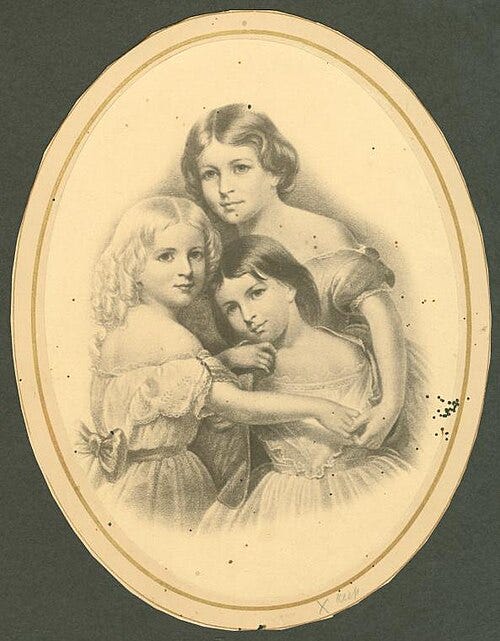
Between the dark and the daylight,
      When the night is beginning to lower,
Comes a pause in the day's occupations,
      That is known as the Children's Hour.

I hear in the chamber above me
      The patter of little feet,
The sound of a door that is opened,
      And voices soft and sweet.

From my study I see in the lamplight,
      Descending the broad hall stair,
Grave Alice, and laughing Allegra,
      And Edith with golden hair.

A whisper, and then a silence:
      Yet I know by their merry eyes
They are plotting and planning together
      To take me by surprise.

A sudden rush from the stairway,
      A sudden raid from the hall!
By three doors left unguarded
      They enter my castle wall!

They climb up into my turret
      O'er the arms and back of my chair;
If I try to escape, they surround me;
      They seem to be everywhere.

They almost devour me with kisses,
      Their arms about me entwine,
Till I think of the Bishop of Bingen
      In his Mouse-Tower on the Rhine!

Do you think, O blue-eyed banditti,
      Because you have scaled the wall,
Such an old mustache as I am
      Is not a match for you all!

I have you fast in my fortress,
      And will not let you depart,
But put you down into the dungeon
      In the round-tower of my heart.

And there will I keep you forever,
      Yes, forever and a day,
Till the walls shall crumble to ruin,
      And moulder in dust away!

Word & Song is an online magazine devoted to reclaiming the good, the beautiful, and the true. To support this work, please join us as a subscriber.
We think of our archive as a little treasure trove. Our paid subscribers have on demand access to the entire of Word & Song, many hundreds of entries. For everyone else, there’s always plenty to see here, as well. We hope that all of our readers will revisit and share our posts with others as we continue our mission of reclaiming — one thing at a time — the good, the beautiful, and the true.


