

Back to School Special.
Last Day!
Upgrade to paid or give a year’s subscription at half price.
If you know a college student who is entering college or returning to the trenches of higher education, why not sign them up for a year of Word & Song?
We’re admittedly old fashioned here! But we believe that now more than ever, college students—all young people—need daily doses of
the good, the beautiful, and the true.
When I was in Catholic grade school, the state of Pennsylvania told us that we had to have physical education one hour a week, even though — at least until the state heaped other extra duties on us — the sisters who ran the school gave us a full hour for recess, and most of us walked to and from school, and sometimes we walked home for lunch and came back. Now, the school was built with three stories (or storeys, to use the old spelling), the third for a big auditorium with a stage for plays, which was also a basketball court with bleachers. The town’s public high school across the street from us did not have a court, so we let them use ours; and once a week the Catholic students at the public school were sent over our way after dismissal, for religious instruction, the teachers making sure on their end that they got to our end. It was a matter-of-fact cooperation between the town and the parish. No Supreme Court judges needed to be involved!
Anyway, the sisters decided that the best thing to do was to hire a dance instructor, and there’s our Word of the Week. It wasn’t a bad idea, but it could have come at a better time. You see, this was around 1970, and dancing had quickly gone mainly from what boys and girls did together, to what you did singly, perhaps while looking at your dance partner, though from what I saw later on, a lot of the time the “partner” wasn’t there at all. I still remember the funky names of some of the dance moves: the Froog, the Popcorn, the Jerk, the Watusi. Mr. Lannak, the instructor, was a friendly sort, and he did also have us learn the rudiments of the waltz, and dance the polka, and a few things like that. The trouble for me was that once I went to high school, nobody was dancing that way, and I quickly lost what little I’d learned. If only we’d had the Virginia Reel!
Or the tarantella — and when I say that word, immediately a picture flashes before my eyes. It’s my great Aunt Helen, an Italian matron of the classic sort, short, strong, portly, quite handsome, whirling in dance while everybody around laughs and cheers. It’s one of the great old customs of southern Italy, a courtship dance called, yes, the spider-dance for its motions of arms and legs. Apparently tarantula was so named from the town of Taranto, on the seacoast in Puglia, founded by Spartan colonists 2,700 years ago. Anyway, I don’t think any of us cousins learned that dance, just as we didn’t learn such American dances as the Charleston, the jitterbug, or the Big Apple, or any swing dances. Ah well. One time, just once, at our eating club at Princeton (Dial Lodge, which no longer exists; a great big ugly economics building now stands where I once took my meals with 90 other students and beat all comers at pool and ping-pong), we had somebody show us how to do square dancing, and it was thoroughly delightful. Mainly, for us, dancing had become a series of spasms across a floor, in the dark, with pounding and aggressive music, or “slow” dancing, which meant little more than holding a girl and swaying a little bit while moving your feet now and then.
But I do know that when I visited Benedictine College back in 2010 or thereabouts, it was full of happy students without any confusions concerning boys and girls, and the two young ladies who showed me around the campus brought me to a big entrance hall in one of the buildings, and there, they said, they had weekly swing dances. It wasn’t organized by the professors. The students themselves organized it, for fun — there, for innocent and healthy fun with the boys and girls dressed up for it. I have wondered sometimes whether we’d do well to remember that not everybody enjoys theological discussion, and that the most urgent need for us now is to get the young people married — that’s if we want to have healthy neighborhoods again, with a lot of children and their noisy and glorious play.
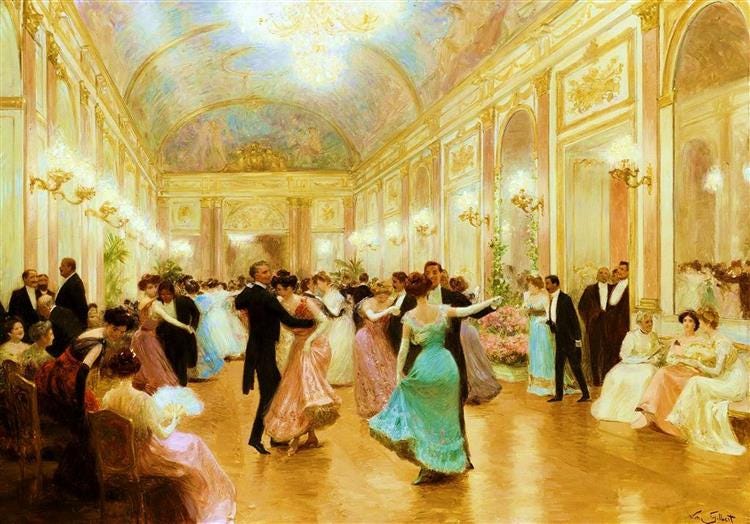
Milton looked askance at “mixed dance,” that is, men and women dancing together, and sure enough, in a lot of traditional cultures, men dance with men and women with women. Think of the stir in Fiddler on the Roof, when Hodel, Tevye the milkman’s second daughter, dances with Perchik, the young revolutionary fellow she’s in love with. But dancing wasn’t just for personal feelings. There’s dancing in all of the ancient Greek plays — the Chorus would be doing the dancing, but what they did, how they moved, what music accompanied them, we don’t know. Every human culture has some kind of dancing, a way to make the body itself into a symbol of music and order. The ancient Chinese took their music and dancing so seriously, it was believed that you’d endanger your very country if you corrupted them. Christians looked upon the heavens above and saw dancing — they saw order and beauty in the stars, the planets, the sun, and the moon, and all their intricate motions. The idea is that the dance of man below should reflect the dance above.
The word dance came into English from the Anglo-Normans, our invading friends who spoke their Norman dialect of French. It supplanted Old English sealtian, itself from Latin saltire, brought into our language from the first Romans who conquered Britain up to Hadrian’s Wall. Think of French sauter, to leap, as in our word somersault. Modern French danse is thus very closely related to English dance and German Tanz, not cousins but siblings. But Italians mainly use ballare, to dance; and that’s what we’re talking about in English when we say we’ve “had a ball”. And kids should have more of those, I think!
Listen to this episode with a 7-day free trial
Subscribe to Word & Song by Anthony Esolen to listen to this post and get 7 days of free access to the full post archives.