

Back in 1983, when I visited Italy for the first time, traveling alone for three months (though for four wonderful weeks I stayed with two different sets of cousins), I went to Mantua, falling in with a bus full of lively high school kids from Switzerland, and there we saw the great memorial the Mantovani built in honor of the poet Virgil, who was born there. His tomb is in Naples, built by his patron Augustus Caesar — Virgil died in Brundisium (modern Brindisi), intending to board a ship on his way to Greece. He asked his friends for two favors as he lay dying. One was that they would see to his burial at his villa and farm outside of Naples; that land was a gift from Augustus. The other was that they would burn his nearly-finished poem, the Aeneid. They kept the first promise, and all lovers of poetry will thank them for breaking the second. On that monument in Mantua, I read the words that Tennyson wrote specifically for it, whenever the Mantovani would get round to completing the work. Its last stanza is pure gold:

I salute thee, Mantovano,
I that loved thee since my day began,
Wielder of the stateliest measure
Ever moulded by the lips of man.
He’s talking about the meter that Virgil used not only for his Aeneid but for the rest of his major poems too, dactylic hexameter, Homer’s meter for the Iliad and the Odyssey.
How often do artists craft memorials in honor of a great predecessor? Not often enough, I’d say!
And why don’t they? Vanity, I guess, or envy. But great souls aren’t threatened by the great. Einstein said he wanted to go to Princeton and work there, because he’d get to have lunch with Kurt Goedel — the greatest logician and philosopher of mathematics in modern times, and, by the way, a Lutheran and a devout believer in God. Bach traveled a long way as a teenage boy so he could meet the greatest organist of his day, Buxtehude, and maybe get to study under him. Donatello went to Rome to dig up, under more than a thousand years of sediment and debris, old Roman copies of Greek statuary, to learn from them. And the author of our Poem of the Week, John Milton, was a great man too, and a proud man. His poetic ambitions were immense. And it was he who wrote that the desire for fame is “the last infirmity of noble mind.” Yet when he was 21, he wrote this magnificent tribute to Shakespeare, who had died in 1616, fourteen years before.
If you go to Stratford-upon-Avon, Shakespeare’s birthplace, you can visit the old family home, which has been restored. Originally, the two-story building was walled with wattle-and-daub to fill in a wood frame, but that’s not because the Shakespeare family was poor. For the time, the Bard’s father, John, made a good living. Debra and I visited there on our honeymoon in 1987, so we can’t say what the “Shakespeare Center” next to it is all about, and whether it does justice to the greatest author who ever lived, or whether it’s got more of the same dreary political correctness you find in a lot of memorials now — very often of a sort to try to besmear a great man or chop him down to size.
The wonderful thing about Milton’s tribute is that he says that Shakespeare doesn’t need a big monument, something that would take a lifetime to construct. Even a pyramid for Shakespeare — think of those slave-built tombs that tower up out of the level sands of Egypt — would be unnecessary, and too little at that. When we read Shakespeare’s plays, Milton suggests to us, we become astonished. He takes our breath away. We lose ourselves in wonder. We cannot move. Our minds, our souls become the monuments. Kings themselves, says Milton, would wish to die, if only they could have such a memorial!
It occurs to me that above all, we ought to instill such gratitude and wonder in our students when they study great things. A long time ago, I was in Minneapolis to give a talk on Shakespeare’s Tempest, and I said that wonder was what Shakespeare meant to convey, and most of all, the wonder we should feel when a man dead in sin and guilt is restored to life, since, morally, that is what happens in the play. I also had some hard things to say about teachers who instill in students an attitude of suspicion or political superiority. So it was reported in the student newspaper at the University of Minnesota, that I was opposed to “critical thinking.” Predictable.
Milton, how you would have answered, I shudder to think!
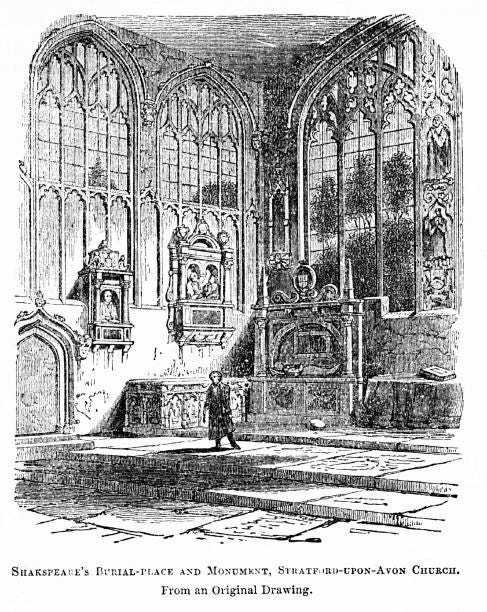
What needs my Shakespeare for his honored bones
The labor of an age in pilèd stones,
Or that his hallowed relics should be hid
Under a star-ypointing pyramid?
Dear son of Memory, great heir of fame,
What need’st thou such weak witness of thy name?
Thou in our wonder and astonishment
Hast built thyself a live-long monument.
For whilst to th’ shame of slow-endeavouring art
Thy easy numbers flow, and that each heart
Hath from the leaves of thy unvalued book
Those Delphic lines with deep impression took,
Then thou, our fancy of itself bereaving,
Dost make us marble with too much conceiving;
And so sepúlchred in such pomp dost lie,
That kings for such a tomb would wish to die.
We think of our archive as a little treasure trove. Our paid subscribers have on demand access to the entire of Word & Song, many hundreds of entries. For everyone else, there’s always plenty to see here, as well. We hope that all of our readers will revisit and share our posts with others as we continue our mission of reclaiming — one thing at a time — the good, the beautiful, and the true.
Listen to this episode with a 7-day free trial
Subscribe to Word & Song by Anthony Esolen to listen to this post and get 7 days of free access to the full post archives.


