


Our word this week is compassion, and you’d think it would be easy to talk about. “Feelings, whoa, whoa, whoa, feelings!” went the song from my teenage years — it sold 3 million records, but you’ll see it on many a list of Worst Songs Ever. Some people are callous and some people are touchy, and some gifted people manage to be both at once. I think that Geoffrey Chaucer was on to that sort of thing with his Prioress in The Canterbury Tales, who feeds her little dogs roasted meat and white bread, when the poor ate black bread and hardly got any meat at all. But if anybody ever went after one of her dogs with a stick, she would weep and moan, because, says Chaucer, “All was sympathy and tender heart.”
For our Poem of the Week, my first thought was to go to William Blake, with his keen sense of outrage at how the poor were treated in the London and the England of his time, especially the children. I think of his look at the chimney-sweeps, those boys, who before they got too big for it, went down the flues to brush and scrape out the soot, breathing it in, so that their lungs must have ended up like black sponges. But that seems too easy. I don’t doubt that Blake was a man of deep sensitivity, who didn’t just profess a distant and comfortable advocacy for the poor. He lived among them himself; he could hardly do otherwise, as his work in poetry and engraving was mostly unknown and unappreciated. Still, that seems to stop short. If there were no suffering in the world, would there be no compassion? Must there be sin, for there to be mercy?
Every virtue, I used to tell my students, is a dynamism, a power, and if that is so, and if compassion is a power, what is its characteristic action? How does it express itself? Our author today, one you’ll recognize as a favorite here at Word and Song, William Wordsworth, would see compassion as inseparable from the imagination in its deepest heart of hearts. Let’s think about this a moment. Another of our favorites, the poet and priest Gerard Manley Hopkins, he also a tireless laborer on behalf of the poor, would go for walks in the countryside and notice things — or more than notice them; he sought to open his mind up to what he called their “inscape,” the world inside them, what makes them the things they are. Man is the single creature in our world whose mind and heart rush forth to enter into those other things, the snaggled apple tree, the white to pink blossoms so prominent against the bare bark, the redbreast gleaning the grubs — “all things original, counter, spare, strange,” as he says. Or as Wordsworth’s friend, the brilliant Coleridge wrote:
He prayeth best who loveth best
All creatures great and small,
For the dear God who loveth us,
He made and loveth all.
And we may think of that man who was all compassion, who saw the kingdom of God in the mustard seed, and a little bit of yeast; who regarded the lilies of the field, and the birds of the air, and loved them, as he loved the hills and the mountains.
So in our poem, Wordsworth gives us a boy who liked to do a boyish thing. He would go into the woods after the sun had set, and make a sound with his mouth and his hands that mimicked the call of the owls, so that they would respond to him. But when they were silent again, he heard things, or experienced them — what he didn’t go out for, but they came to him and he was open to them; the far rush of a mountain stream, or the solemn silence of rocks and hills. “He was just a boy!” the skeptic might say. Just? And it was just the whole mysterious world he was feeling.
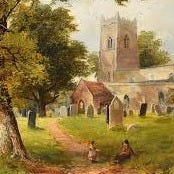
But the poem doesn’t end there. The boy died before he saw his twelfth birthday. And it’s the poet now who stands near the village school and the church, and on summer evenings he has visited the boy’s grave — we don’t know that he has any special reason to do so, or if so, what the reason might be, other than that in the boy he finds a kindred spirit. Or perhaps he himself was one of those boys in that village, and he remembers his old playfellow. He doesn’t say. But he says sometimes he’s spent a half an hour at once, just being there. So the poet too has this power, this movement of the heart outward toward things, and especially toward someone who called with the owls, and walked in the hills when night was falling. Coleridge said of the lines that end the first stanza, “I should have recognized them anywhere; and had I met these lines running wild in the deserts of Arabia, I should have instantly screamed out, ‘Wordsworth’!”
Word & Song is an online magazine devoted to reclaiming the good, the beautiful, and the true. To support this work, please join us as a subscriber.

There was a Boy; ye knew him well, ye cliffs
And islands of Winander! -- many a time,
At evening, when the earliest stars began
To move along the edges of the hills,
Rising or setting, would he stand alone,
Beneath the trees, or by the glimmering lake;
And there, with fingers interwoven, both hands
Pressed closely palm to palm and to his mouth
Uplifted, he, as through an instrument,
Blew mimic hootings to the silent owls
That they might answer him.—  And they would shout
Across the watery vale, and shout again,
Responsive to his call,— with quivering peals,
And long halloos, and screams, and echoes loud
Redoubled and redoubled; concourse wild
Of jocund din!  And, when there came a pause
Of silence such as baffled his best skill:
Then sometimes, in that silence, while he hung
Listening, a gentle shock of mild surprise
Has carried far into his heart the voice
Of mountain-torrents; or the visible scene
Would enter unawares into his mind
With all its solemn imagery, its rocks,
Its woods, and that uncertain heaven received
Into the bosom of the steady lake.

This boy was taken from his mates, and died
In childhood, ere he was full twelve years old.
Pre-eminent in beauty is the vale
Where he was born and bred: the churchyard hangs
Upon a slope above the village-school;
And through that churchyard when my way has led
On summer evenings, I believe that there
A long half-hour together I have stood
Mute — looking at the grave in which he lies!
We think of our archive as a little treasure trove. Our paid subscribers have on demand access to the entire of Word & Song, many hundreds of entries. For everyone else, there’s always plenty to see here, as well. We hope that all of our readers will revisit and share our posts with others as we continue our mission of reclaiming — one thing at a time — the good, the beautiful, and the true.


