

Well, it’s a rare enough event when for our Poem of the Week I choose something written in free verse! It isn’t the first time. We’ve had Christopher Smart’s praise of God for his cat Jeoffrey, written as if it were a psalm, and T. S. Eliot’s strangely somber Journey of the Magi, and one of these days I’ll give you a selection from Charles Peguy’s Portal to the Mystery of Hope, a poem in which each “verse” in the free-verse ends with a period, whether or not it’s a sentence. The best free verse, in my opinion, has a musical structure to it, so that you can’t really imagine ending the lines other than as they do; you still hear the poem in musical strands, rather than just see lines arranged on a page. I think that Carl Sandburg’s famous poem “Chicago” fits the bill.
For a couple of years, Debra and I and our baby Jessica lived in South Carolina, in the “upcountry” as they used to call it, a short drive along the foothills into North Carolina and the village of Flat Rock, where Sandburg and his wife lived after 1945, moving there from the midwest for the peace and quiet of it, and for a good lot of acreage, because Lillian Sandburg raised flocks of goats. Still, he was an Illinois man to the core. He had just completed his biography of Abraham Lincoln, which is on a shelf a few feet away from me as I write these words, and he had already been on this earth for as long as I have, which is certainly long enough. I don’t have to agree with his socialist-leaning politics to note that when he was young, the fights were about work — often grueling or dangerous, in the steel mill, the copper mine, the lumberyard, on the docks, at the saw or the pile driver or the jackhammer or the riveter. The work itself demands our respect.
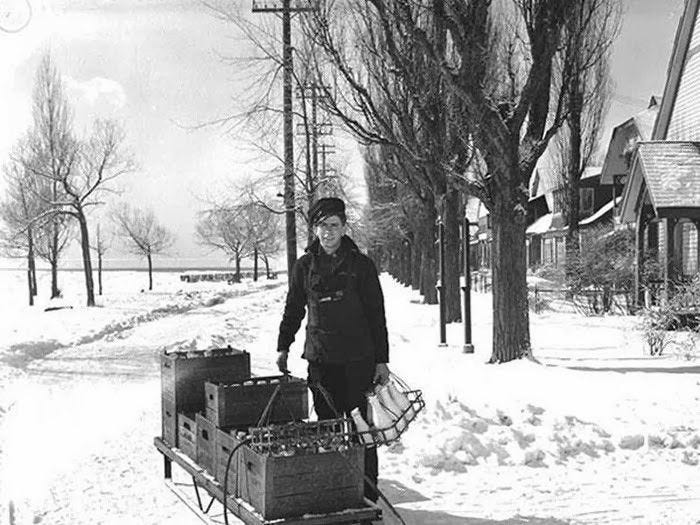
And Sandburg wasn’t slumming it when he wrote about such work. He left school at age 13. He drove a milk wagon. He laid bricks. He plowed the earth in Kansas. He shoveled coal in Omaha. He signed up for the infantry in the Spanish-American War, though he did not see action. He never did get a college degree, though he was a voracious reader, and his interests were very broad. Imagine a famous poet of our own time accompanying himself on the guitar, a sort of folk-poet or folk-singer of the city. That’s what Sandburg was. You may have gathered that I don’t gravitate toward cities, and if you asked me which American city is my favorite, I’d be hard put to answer. But that’s me. Sandburg, for all that he grew up in the farm town of Galesburg, IL, fell in love with the brawling city of Chicago, in the days before Prohibition and the rise of Al Capone and organized crime, but not before the stockyards of that city were the largest in the world, butchering 400 million steers and sheep and goats from 1865 to 1900. If you were an American eating meat you had not hunted or raised yourself, chances were more than 80% that it came through Chicago.
And if you want a piece of poetic Americana, as the nation’s 250th anniversary draws near, I think that this poem is as good as any — for the youth it celebrates, the energy, the fearlessness, and a certain kind of liberty, not the highest kind to be sure, but not to be scorned absolutely, either.
Hog Butcher for the World,
   Tool Maker, Stacker of Wheat,
   Player with Railroads and the Nation's Freight Handler;
   Stormy, husky, brawling,
   City of the Big Shoulders:

They tell me you are wicked and I believe them, for I have seen your painted
   women under the gas lamps luring the farm boys.
And they tell me you are crooked and I answer: Yes, it is true I have seen the
   gunman kill and go free to kill again.
And they tell me you are brutal and my reply is: On the faces of women and
   children I have seen the marks of wanton hunger.
And having answered so I turn once more to those who sneer at this my city,
   and I give them back the sneer and say to them:
Come and show me another city with lifted head singing so proud to be alive
   and coarse and strong and cunning.
Flinging magnetic curses amid the toil of piling job on job, here is a tall bold
   slugger set vivid against the little soft cities;
Fierce as a dog with tongue lapping for action, cunning as a savage pitted
   against the wilderness,
      Bareheaded,
      Shoveling,
      Wrecking,
      Planning,
      Building, breaking, rebuilding,
Under the smoke, dust all over his mouth, laughing with white teeth,
Under the terrible burden of destiny laughing as a young man laughs,
Laughing even as an ignorant fighter laughs who has never lost a battle,
Bragging and laughing that under his wrist is the pulse, and under his ribs the
   heart of the people,
                   Laughing!
Laughing the stormy, husky, brawling laughter of Youth, half-naked, sweating,
   proud to be Hog Butcher, Tool Maker, Stacker of Wheat, Player with
   Railroads and Freight Handler to the Nation.
We think of our archive as a little treasure trove. Our paid subscribers have on demand access to the entire of Word & Song, many hundreds of entries. For everyone else, there’s always plenty to see here, as well. We hope that all of our readers will revisit and share our posts with others as we continue our mission of reclaiming — one thing at a time — the good, the beautiful, and the true.


