


Here is another message in a bottle, courtesy of Word and Song.
I’m looking at an 1899 copy of a journal called The Book-Lover. It’s where you’d go in the United States if you collected rare books or other items having to do with authors and their lives. Lot 77 is a letter, dated March 15, 1870, from Oliver Wendell Holmes (the poet, not his amoralist son who served on the Supreme Court) to John Greenleaf Whittier, on reading our Poem of the Week, “In School-Days.” Let me quote the passage that the auctioneers thought would bring in the highest bids:
“I am especially pleased with your kind note, because it gives me the opportunity to speak of your own lines, which for grace and infinite tenderness, you have never surpassed. I will say it — Who has? I mean the lines, 'In School Days’ . . . It melted my soul within me to read these lovely verses. You may think I praise them more than I should, if I had not been made partial by your liking some things of mine. It is not so. I had no sooner read them than I fell into such ecstasy about them that I could hardly find words too high-colored to speak of them to my little household. I hardly think I dared read them aloud. My eyes fill with tears just looking at them in my scrap-book, now, while I am writing. You did not expect this, but you must submit to it. Many noble, many lovely verses you have written; none that go to the heart more surely and sweetly than these.”
If you wanted to buy that letter in 1899, it would cost you $230, which in today’s terms would be about $9,500. Whittier had passed away by then; I’m sure he would be mortified by such a thing.
What moved the heart of Mr. Holmes? His own memories of childhood and of the one-room schoolhouse that the poem, in a glancing way, commemorates. I met an elderly woman on Prince Edward Island who had gone to such a schoolhouse, and she told me she would not have traded it for anything. It was, or at least it could be, quite a human place, small, on the scale of the small images of God who would be taught there, and not lonely, since it was but the life of a village and its families concentrated for some hours a day in one room. Children learned at their own pace, but since the youngest would overhear the lessons of their elders, and the eldest the lessons of their juniors, there was a continual anticipation and preparation and review and remembrance going on all the time.
In Whittier’s poem, the schoolhouse still stands, though it appears no longer to be in use. Whittier recalls one day especially, a day of disappointment but also exhilaration. It seems there had been a spelling bee, and the speaker of the poem, whom we may as well identify with the poet himself, lost at the final word. The girl who won tells him that she’s sorry she did — and she gives as her reason for being sorry the most ordinary thing in the world, and yet the most startling and memorable. More than forty years later, he still recalls it, as he looks around the old building, bearing its traces of a life that has departed from it. In the harder school of life, to which he says he has graduated, many a man will have passed him by, and never given a second thought to their triumph or his loss, never felt a single throb of sympathy.
No one in our time writes a poem like this one, because no one has the feelings that nurtured it. The poem is gentle in its humor, light-hearted in its memory of childhood, but a kind of solemnity runs through it too, from the first two lines that suggest a time that will not come again, to the final lines, that bespeak a wistfulness, a touch of sorrow at the heart of man so often shut, but expressed without bitterness, without blame. Was Whittier the greatest American poet of his time? No, not at all; but then, he never pretended to be. Was he the most beloved? He or his fellow “fireside poet,” Longfellow.
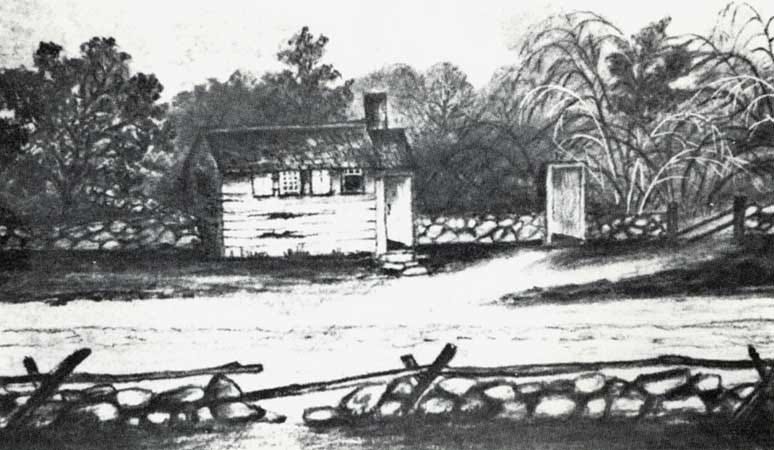
Still sits the school-house by the road,
   A ragged beggar sleeping;
Around it still the sumachs grow,
   And blackberry-vines are creeping.

Within, the master’s desk is seen,
   Deep scarred by raps official;
The warping floor, the battered seats,
   The jack-knife’s carved initial;

The charcoal frescos on its wall;
   Its door’s worn sill, betraying
The feet that, creeping slow to school,
   Went storming out to playing!

Long years ago a winter sun
   Shone over it at setting;
Lit up its western window-panes,
   And low eaves’ icy fretting.

It touched the tangled golden curls,
   And brown eyes full of grieving,
Of one who still her steps delayed
   When all the school were leaving.

For near her stood the little boy
   Her childish favor singled:
His cap pulled low upon a face
   Where pride and shame were mingled.

Pushing with restless feet the snow
   To right and left, he lingered;—
As restlessly her tiny hands
   The blue-checked apron fingered.

He saw her lift her eyes; he felt
   The soft hand’s light caressing,
And heard the tremble of her voice,
   As if a fault confessing.

“I’m sorry that I spelt the word:
   I hate to go above you,
Because,”—the brown eyes lower fell,—
   “Because, you see, I love you!”

Still memory to a gray-haired man
   That sweet child-face is showing.
Dear girl! the grasses on her grave
   Have forty years been growing!

He lives to learn, in life’s hard school,
   How few who pass above him
Lament their triumph and his loss,
   Like her,—because they love him.
We think of our archive as a little treasure trove. Our paid subscribers have on demand access to the entire of Word & Song, many hundreds of entries. For everyone else, there’s always plenty to see here, as well. We hope that all of our readers will revisit and share our posts with others as we continue our mission of reclaiming — one thing at a time — the good, the beautiful, and the true.


