


“So foul and fair a day I have not seen,” says Macbeth, his first words in the play, and though he doesn’t know it, he has just summed up the moral spiral into which he’s about to fall. What he means is that the weather is wretched, but all’s gone very well for the Scottish royal army against the invading king of Norway and his powerful ally in Scotland, the Earl of Cawdor. But we’ve already seen the ladies who aim to cross Macbeth’s path, the “weird sisters,” and they have chanted, shrieking away, “Fair is foul, and foul is fair, / Hover through the fog and the filthy air.” Really? Can that be so? Can fair be foul and foul be fair? Only if we equivocate, that is, only if we deliberately use words in different senses, so that what is fair in one way can be foul in another, and vice versa. But those same witches want to deceive Macbeth by equivocation, leading him to credit one sense of what they say so that he will miss the truth. “That’s not fair,” you’ll say, using our Word of the Week, and you’re right, it isn’t.
But let’s tease this out a little. When we say that something isn’t fair, we don’t necessarily mean that it’s against the law. Sometimes it is, but more often it isn’t. We mean something that’s both less and more than that. We mean that it cuts across our sense of what is right or straight in our relations to someone else. It’s crooked or devious or underhanded. Notice that all those words have to do with concealment or misdirection. But a man who is fair in his words and deeds is what we began to call, in the 1600’s, a “plain dealer.” And there’s the old saying, “Handsome is as handsome does,” and that too gets at a good part of the meaning of fair. The phrase “fair play” originally described things you’d do with your free time that were handsome or decorous, say, singing a merry song, or playing a game of rounders, or setting out with your friends to go swimming. And “foul play” originally described the opposite, forms of “play” that were ugly or mean or dirty or low-down: maybe like shooting craps in the alley while the drinks are going round, or setting fire to your neighbor’s outhouse, for the fun of it. What’s fair is decent, above-board, handsome, a pleasure to behold; what’s foul is indecent, sneaky, ugly, and spiteful.
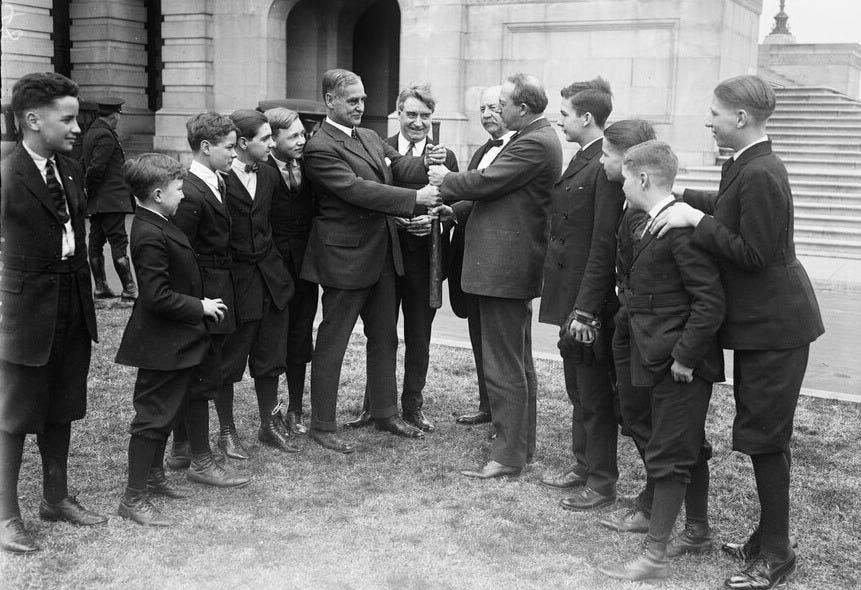
When I was a boy, we played ball all the time, with no grownups to organize us or direct us or call the plays. Thus we developed a keen sense of what was fair — and I’m not just talking about a batted ball. By the way, it surely is a linguistic anomaly that in baseball, the foul line is in fair territory, and a fly ball that hits the foul pole is a home run! Anyway, fairness had always to govern what we did, if only so that we could enjoy a good game. Choosing up sides had to be fair, otherwise the game would be a slaughter, and no fun. If we were playing slow-pitch ball, we had an unstated agreement that to throw the ball beyond a certain speed was not fair. You couldn’t get in somebody’s way when he was rounding the bases, unless you had the ball in hand. You couldn’t take a wicked swipe at somebody’s head to tag him out. And close plays had to be judged fairly. It was wrong — it was bad form, not good-looking, not square — to shout that you were safe when you knew you were probably out. You had to learn to separate what you wanted to see from what you did see. And certain players with keen eyes and cold judgment could be relied on to call the play as they saw it, whether it favored them or not. This sort of thing actually happened sometimes in professional baseball in the early 1900’s, when the great Christy Mathewson was on the mound. Mathewson — a favorite son in our neck of the woods, growing up about 20 miles from my town — was strong, handsome, intelligent, scrupulously honest, deeply devout, and fair. I can’t find anybody who ever had a bad word to say about him. Anyway, in those days, sometimes they had only one umpire, or two, and that meant that the umpire might be in a bad position to call a play at one of the bases. Occasionally, the ump would say, “How about it, Matty, what was he?” And Mathewson would call it as he saw it, and everybody would accept the call.
You see, when you are fair, when decency and even-handedness rule the day, rather than foulness and gross favoring of one side over the other, you can have a lot of fun. Everything runs more smoothly — businesses, schools, friendships, games, clubs, nations, and even churches, speaking only on a human level. English boys used to learn fairness by playing cricket, which, like baseball, requires the players to stay within what’s right, and to judge close plays with a steady eye and cool spirit. Something that is “not cricket” is not fair, even if, technically, it doesn’t involve cheating.
The word is a very old one: Old English faeger, pronounced FAEH-yehr, with the g as a hard y. It meant “beautiful,” “pleasant,” “delightful.” We have those meanings still: think of fair weather, or a fair maiden. When, after the invasion of the Normans, those Vikings who spoke French and were often blond came to rule in England, the standard for beauty was to have light hair, the word fair came to suggest a light complexion or blondness: hence the phrase a fair-haired boy, for a lad in favor with the boss or the schoolmaster. The word’s applications are pretty broad, but you’ll notice that they all touch upon evenness, straight speaking, balance, just judgment, or beauty. In case you’re wondering, the noun fair, meaning the place where you go to buy things or to eat funnel-cake (that’s a Pennsylvania thing) or go on the rides or look at the prize cows and pigs is a completely different word. It comes to us from Middle English feyre, from Old French and ultimately from Latin feria, a feast-day. But if you go to Vanity Fair, don’t expect fair dealing!
We think of our archive as a little treasure trove. Our paid subscribers have on demand access to the entire of Word & Song, many hundreds of entries. For everyone else, there’s always plenty to see here, as well. We hope that all of our readers will revisit and share our posts with others as we continue our mission of reclaiming — one thing at a time — the good, the beautiful, and the true.
Listen to this episode with a 7-day free trial
Subscribe to Word & Song by Anthony Esolen to listen to this post and get 7 days of free access to the full post archives.


