


Dear Readers, I have the perfect poem for our week and for today’s solemnity, Ash Wednesday, and for our Word of the Week, ash.
Is it from the Middle Ages? No, not at all. Popular entertainment and the lingering prejudices of the Enlightenment have caused people to suppose that in the Middle Ages art, like life, was dark and grim. Maybe it’s because we have a skewed impression of their grand cathedrals, which were coated with soot and grime not from the Middle Ages, when they shone like jewels encased in gleaming white, but from the Industrial Revolution centuries later. That’s when, as Dickens described it, snow in London wasn’t reliably white. Sometimes it was sooty before it hit the ground. As I’ve said many times, the years 1000-1300 were grand for Europe, in part because the weather was so warm, the Vikings could grow barley on the coasts of Greenland; in part because the Vikings themselves were converted to the Christian faith, and their pacification made sea trade and, in eastern Europe, overland trade too, a lot less risky; and in part because of the sheer energy of medieval man and of the Church with its widespread intellectual, social, and agricultural networks. Anyway, people during that time were not obsessed with death and dying. That’s when good rousing love poetry returned to the west after a long hiatus. You had roving troubadours; people on colorful pilgrimages; new religious orders in the towns rather than separated in monasteries; guilds of artisans and craftsmen; international trade in everything from English tin and raw wool to spices from the east, worth their weight in gold; and much more.
Then the Little Ice Age began, harvests were poorer, and the Black Death hit in 1348. That’s at the very end of the Middle Ages. It’s the Renaissance, not the Middle Ages, when you start to find social habits preoccupied with death, and art to reflect the preoccupation. You’ve heard the Latin phrase, Memento mori? That means, in good concise Latin form, Remember (that you are going) to die. In some places, people wore rings with that inscription, or engraved with a skull and crossbones. Thomas More wasn’t the only man who kept what was called a “death’s-head” on his desk, as a reminder — a skull. Even in their mirth, there was often a dash of darkness. One popular motif in art would involve a skeletal Grim Reaper with his sickle, dancing unseen amidst people in celebration or enjoying their sunny days of youth. The message was this: “Et in Arcadia ego,” meaning, “I, (Death), am here, even in Arcadia.”
I suppose that there are two basic ways to err in dealing with that certainty. Both are born of fear. One is to be morbidly preoccupied with it. The other is to flee all thought of it. In our time, that dread is exacerbated by our experiences with hospitals, where we seem to lose our humanity. My grandfather, when he was dying, refused to be taken to the hospital. My father also died at home, surrounded by his family. I don’t want the last thing I see on earth to be ceiling tiles.
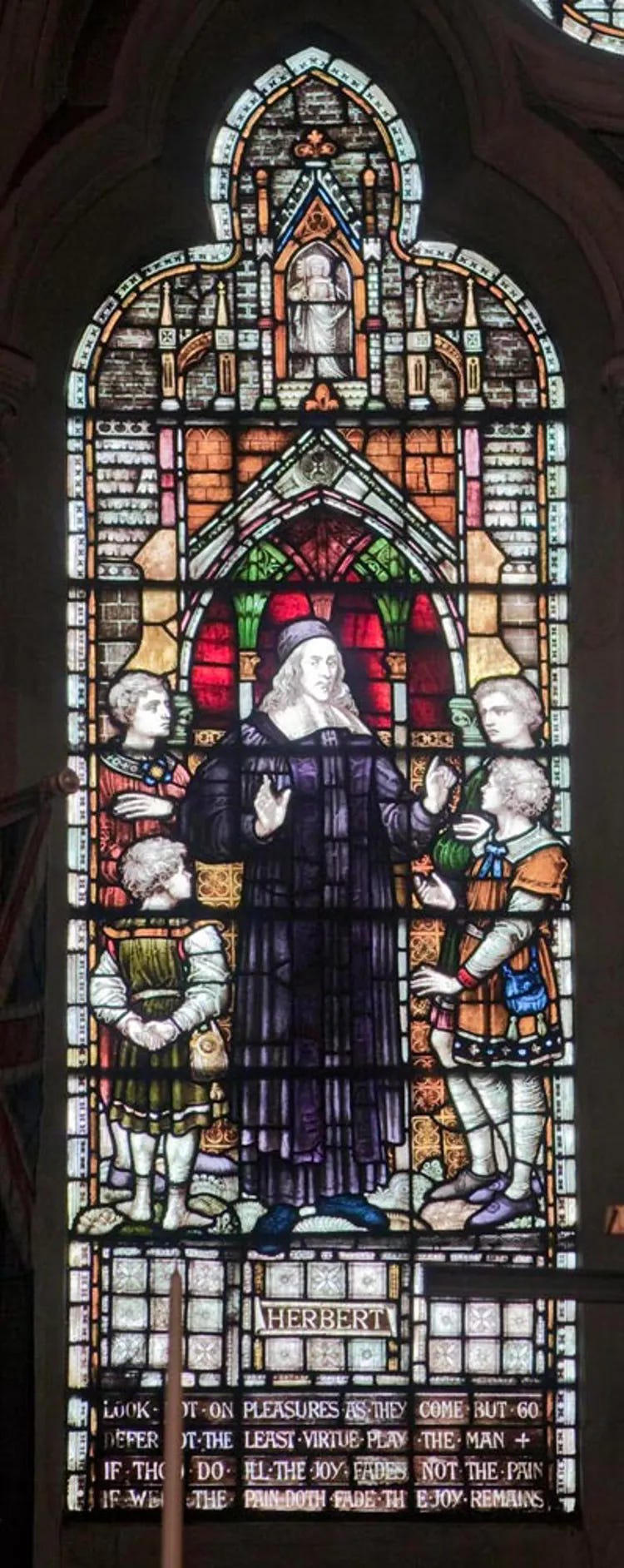
But it is healthy to prepare, long beforehand, for the time that will come, inevitably, and that’s what our poet this week, George Herbert, is doing in this poem, “Church Monuments.” The speaker is a pastor, and the scene is a churchyard — the cemetery, on the church grounds. He is thinking not of any particular person buried there, but of dust and earth: and we may remember here the Ash Wednesday adjuration: “Remember, Man, that thou art dust, and unto dust thou shalt return.” Sin — our “crimes,” as he says — feeds the “incessant motion” of death, and drives us all to our graves. What we should do, then, is let meditation upon death set us to school. What elements are we made of? See the dust and earth. Should you read the lines engraved on the monuments, to denote who lies there? The “dusty heraldry and lines” are not on the stone but in the earth. They “laugh at Jet and Marble” — that is, they laugh at black obsidian or bright marble. The engravings tell us who lies there, but what good will they be when the monuments themselves “bow, and kneel, and fall down flat / To kiss those heaps which now they have in trust”? Then the dust of the stones will lie flat upon the dust of the earth and the dust of the bodies. Even the stones cry out to us, “We too must pass away!”
But Herbert saves the most daring metaphor for last. Think of the dust of an hourglass, sifting away, inevitably dwindling: that’s what the poet says our flesh is. My body is glass through which the sands of time fall away; and even the glass itself will fall to dust. Consider how tame the ashes are in the grave, he says, and learn the lesson, to “fit thyself against thy fall,” meaning, to get ready, to be in trim for the fall that must come; or, with a different sense to the preposition “against,” to fit yourself against or in opposition to the fall. The two meanings are in accord.
Notice, too, that there are two words that dominate the poem: dust and earth. Dust is one of the rhyming words in stanzas 1, 3, and 4, rhyming on trust in the first two, and rhyming as we might say against the word lust in the last stanza. In the second stanza, we have the word earth in place of dust, as a rhyming word, rhyming with birth, and that too is quite deliberate. We aren’t to despise the flesh. Herbert calls it “dear,” meaning cherished, even precious; and he isn’t being ironic there. We must believe that it is only earth. But it is also to be raised up again, in the new heaven and new earth. For sometimes dust is not charcoal. Sometimes it is gold.
While that my soul repairs to her devotion,
Here I entomb my flesh, that it betimes
May take acquaintance of this heap of dust,
To which the blast of death's incessant motion,
Fed with the exhalation of our crimes,
Drives all at last.  Therefore I gladly trust

My body to this school, that it may learn
To spell his elements, and find his birth
Written in dusty heraldry and lines,
Which dissolution sure doth best discern,
Comparing dust with dust and earth with earth.
These laugh at Jet, and Marble put for signs

To sever the good fellowship of dust
And spoil the meeting.  What shall point out them
When they shall bow and kneel and fall down flat
To kiss those heaps, which now they have in trust?
Dear flesh, while I do pray, learn here thy stem
And true descent; that when thou shalt grow fat

And wanton in thy cravings, thou mayst know
That flesh is but the glass which holds the dust
That measures all our time; which also shall
Be crumbled into dust.  Mark here below
How tame these ashes are, how free from lust,
That thou mayst fit thyself against thy fall.

Word & Song is an online magazine devoted to reclaiming the good, the beautiful, and the true. To support this work, please join us as a subscriber
We think of our archive as a little treasure trove. Our paid subscribers have on demand access to the entire of Word & Song, many hundreds of entries. For everyone else, there’s always plenty to see here, as well. We hope that all of our readers will revisit and share our posts with others as we continue our mission of reclaiming — one thing at a time — the good, the beautiful, and the true.


