


Please join us as a paid subscriber or give a gift subscription at our Easter “forever” discount rate. Already a paid or founding subscriber? Watch your inbox for an Easter gift from Word & Song.
A happy and glorious Easter to all our readers and to your families!
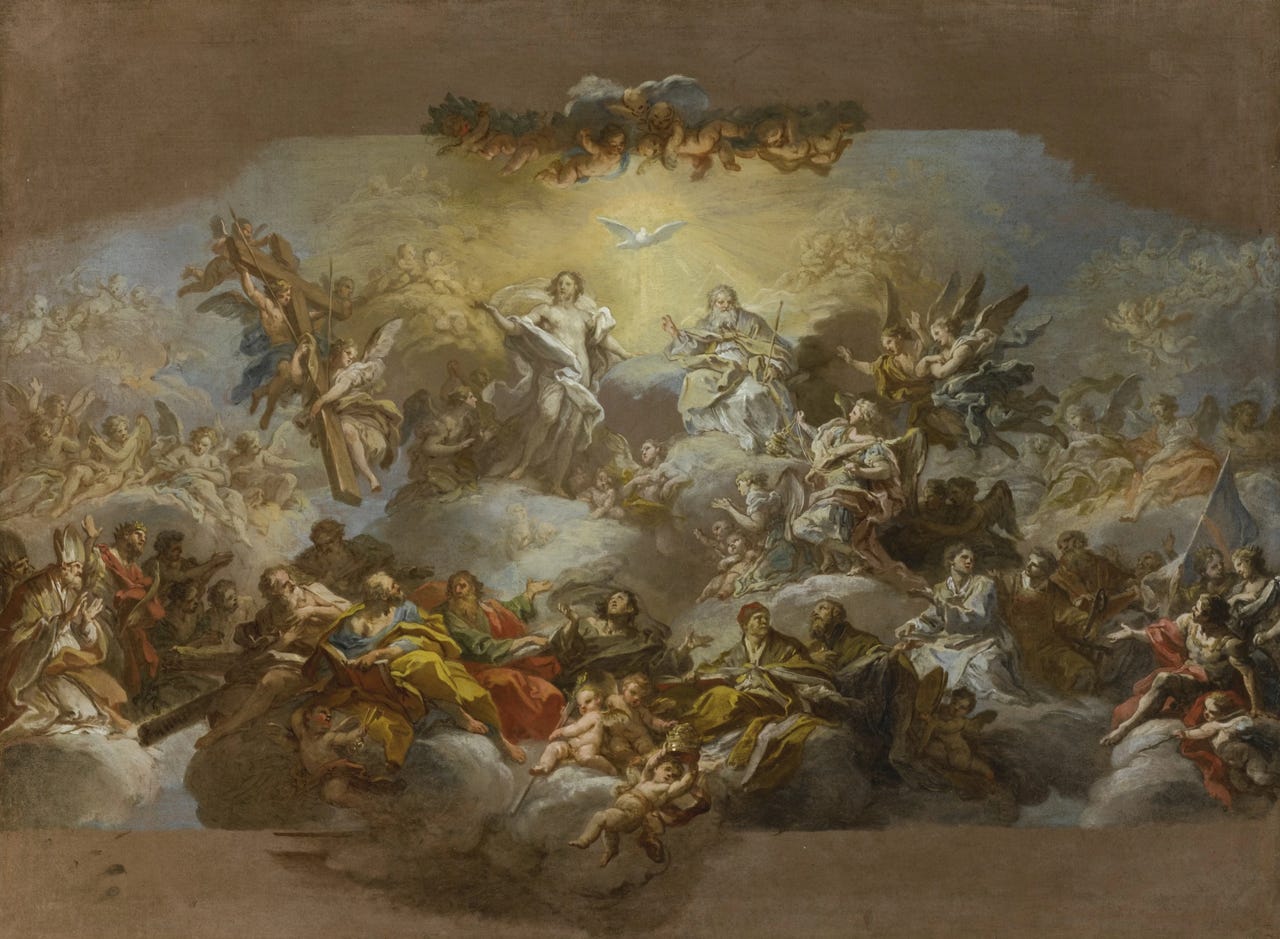
And it’s no surprise that our Word of the Week should have to do with the blessed season of Eastertide. I’ve chosen the word glory, not because we know a great deal about that word and its origins and its kin — in fact we don’t. It comes to us, through the French, from Latin gloria, and we’re not sure where that comes from. Rather, I’ve chosen it because it seems that every language manages to shed light on some one or two features of glory, but not on all of the features, as if no human means could do justice to the thing itself.
So then let’s start from the Hebrew word for it, chabod, meaning “abundance, honor, glory.” “May the glory of the Lord endure forever,” sings David in the psalm,
who looks on the earth and it trembles,
who touches the mountains and they smoke!
There we see the glory of the Lord in power, such power as must shake man to the depths of his soul. “In the morning you shall see the glory of the Lord,” says Moses to the children of Israel, whom God has set free from their bondage in Egypt, but it isn’t a light-hearted and pleasant thing. For they have been grumbling against Moses, which means they have been grumbling against God, because they need food, and some of them want to go back to the stew-pots of Egypt. God is going to send them the bread of heaven, the manna — and “manna” itself is an ironical name, since it means, “What’s this?”, which is what the people said when they first saw it. But to be near the glory of God, for them, is like being in the shadow of a mountain when it trembles.
And that’s exactly right, since chabod comes from the root verb cabed, “to be heavy, to have weight.” That could be said of the burden on your back, or the troubles you must endure, as when the vindictive Pharaoh lays “heavier work on the men” he has made into slaves. But it is also often said of the divine. So Manoah, Samson’s father-to-be, uses an intensive form of the verb when he says to the angel, “What is your name, so that, when your words come true, we may honor you?” — meaning, “that we may heap you with all the weight of glory.” C. S. Lewis was careful to note the sense of the Hebrew here, and that’s why he called his book of essays The Weight of Glory.
But the Greek word doxa, the word for glory in the New Testament, doesn’t carry those associations. Instead it suggests high repute, praise: a participial form of the word is what you get in the Greek Psalms, for “Glorious things of thee are spoken, City of God!” So when Saint Paul says that we’re to eat and drink and do all that we do “for the glory of God,” that’s the word he uses, and he means by it that our deeds are to become works of praise. That sense of the word is also present in Latin gloria. Now, in Latin the adjective gloriosus wasn’t always meant in praise: one of the stock characters in Roman comedy was the “miles gloriosus,” meaning “the soldier who’s always bragging about himself,” and often for feats in battle which he never actually performed. I think the idea is that glory in this sense, like praise, is something that others bestow upon you, and not what you deck yourself in to show off.
Now that sense, oddly enough, brings me to one of my favorite words in Welsh, gogoniant, which means “glory,” and that’s what you’ll see in the Welsh Bible, but it comes from gogawn, which has two main features to it. If it’s a noun, it suggests the kind of glory you sing about; as an adjective, it suggests that you are manly and strong. Of course you would apply it to Jesus, who triumphed over man’s mightiest foes, sin and death.
Yet there’s still one really important association I haven’t touched upon, and for this one we go to English — but Old English, before the word from French replaced our older Germanic word, which was wuldor. Isn’t that a fine word? Caedmon, the illiterate cowherd turned sacred poet, in the first hymn he ever composed, called this whole world the “weorc Wuldorfaeder,” the “work of the Glory-Father,” and he meant us to look up and behold it in all its splendor. That’s what wuldor suggests: radiance, light, splendor, beauty, wonder. It is something to see, to behold, so we shouldn’t be surprised to find that it’s a cousin of Latin vultus, the face, the countenance. And that may be the most glorious thing of all that we can say about our God, who says to us, in the psalm, “Seek my face.”
Word & Song is an online magazine devoted to reclaiming the good, the beautiful, and the true. To support this work, please join us as a subscriber.

Out of the bosom of eternal bliss
In which he reigned with his glorious Sire,
He down descended, like a most demiss
And abject thrall, in flesh's frail attire,
That he for man might pay sin's deadly hire,
And him restore unto that happy state
In which he stood before his hapless fate.

In flesh at first the guilt committed was,
Therefore in flesh it must be satisfied:
Nor spirit, nor angel, though they man surpass,
Could make amends to God for man's disguide,
But only man himself, who self did slide.
So taking flesh of virgin's sacred womb,
For man's dear sake he did a man become.

And that most blessed body, which was born
Without all blemish or reproachful blame,
He freely gave to be both rent and torn
Of cruel hands, who with despiteful shame
Reviling him, that them most vile became,
At length him nailed on a gallow tree,
And slew the just by most unjust decree.

O huge and most unspeakable impression
Of love's deep wound, that pierced the piteous heart
Of that dear Lord with so entire affection,
And sharply launching every inner part,
Dolors of death into his soul did dart,
Doing him die, that never it deserved,
To free his foes that from his hest had swerved.

What heart can feel least touch of so sore launch,
Or thought can think the depth of so dear wound?
Whose bleeding source their streams yet never staunch
But still do flow, and freshly still redound
To heal the sores of sinful souls unsound,
And cleanse the guilt of that infected crime
Which was enrooted in all fleshly slime.

O blessed well of love, O flower of grace,
O glorious Morning star, O lamp of light,
Most lively image of thy Father's face,
Eternal King of glory, Lord of might,
Meek Lamb of God before all worlds behight,
How can we thee requite for all this good?
Or what can prize that thy most precious blood?
We think of our archive as a little treasure trove. Our paid subscribers have on demand access to the entire of Word & Song, many hundreds of entries. For everyone else, there’s always plenty to see here, as well. We hope that all of our readers will revisit and share our posts with others as we continue our mission of reclaiming — one thing at a time — the good, the beautiful, and the true.
What is a template?
Templates are reusable content blocks you can insert into any post. Use them for content you repeat often, like:
Standard disclaimers or disclosures
Calls to action (subscribe, share, etc.)
Custom dividers or recurring sections
Post templates or boilerplate
To create a template, click "Template" in the editor toolbar and select one to insert. You can organize templates into groups by using "/" in the name (e.g. "Email/Welcome").


