
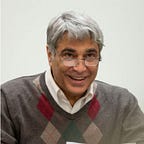

I remember a moment from my freshman class in Moral Philosophy, at Princeton, taught by a very nice man, one T. M. Scanlon, who I don’t think believed in anything religious. This was near the beginning of the term, and he was introducing us to Aristotle’s Ethics, and he said, because of what Aristotle believed about human nature, “I don’t suppose anybody believes in the soul anymore.” Silence. Now that I look back on it, I’ll bet there were still quite a few students in that class who attended Sunday services, or Jewish kids who had not had their faith in God scrubbed entirely away. But nobody said a word. I didn’t, either. I was very shy, and I don’t think I volunteered a single word in any of the lectures for the four classes I took that semester (the other three were Linear Algebra with the math majors, Chemistry, and Introduction to Politics). So I got the idea, and it was an easy one to come up with, that atheism was the default at Princeton. And yet — something wholly unexpected happened, even at Princeton, of all places.
It was the spring semester of my sophomore year. I was going to sign up for a course in Shakespeare, at the departmental level — Shakespeare for English majors. There were two to choose from. Both professors got good reviews from the reliable Princeton Course Guide. It was a tossup. I’m not sure what moved me to choose Professor Thomas P. Roche, Jr., but I did — and that changed my life. For the first time, I became aware of the Christian intellectual life, spanning two thousand years, and then I felt what John Keats felt when he first read Homer in Chapman’s translation. It really was like walking up to the top of a mountain and seeing the Pacific Ocean before you, when you had no idea beforehand that there was such a thing. And that’s when I first learned, among countless other things, about eternity, or its adjective, our Word of the Week, eternal.
Professor Roche brought up Saint Augustine quite frequently and with approval, and that led me to go to the campus bookstore, to buy a copy of Confessions. I can say with complete honesty that if it weren’t for that book, I wouldn’t be here. Now I appreciate the biographical part of Confessions, but at that time, in my youth, when I guess I didn’t think I had much to confess, I was enthralled instead by the four final books, on form, matter, change, identity, memory, time, and eternity. “What is time?” asks Augustine. If no one asks the question, he says, he knows what time is, but as soon as someone does ask it, he no longer knows. Time is bound up with change, and so it is that to ask, “What was God doing before he made the world?” makes no sense, since time is just one of the creatures that God has made. There was no “time” before the created universe, because God had not yet created time. God’s eternity is above and outside of time; he sees all things in his own eternal presence. For an analogy — and it is just an analogy — think of an author of a novel, and imagine that you are a character in the world and the time of that novel. You are inside the book, and the time of the book carries you along, but the author is not subject to the novel-time he has created. For him, in his all-encompassing plan, the last chapter is no farther away than the first. For him, they exist simultaneously.
Now then, let’s continue the analogy, and suppose that the novel is still incomplete. Suppose you were a character in that novel, and that you were made immune from dying. Your life would go on indefinitely. You would live perpetually, but that would still not be eternal life, because it would just be the same kind of life we have now, only without a stopping point. You’d still be in the novel, carried along by time just as anyone else is. It’s not the length of your days on earth that brings you closest to God’s eternity. It is your memory — something perhaps even more mysterious than time.
I’ll grant that it’s hard to express this eternity in poetic form. The Scriptures are pretty chaste about it, but also suggestive. God has set his glory above the heavens: and that means above even those signs in the skies by which we measure time. For “in the beginning God made the heavens and the earth,” and that suggests that time begins only when God wills it to be so, for there was evening and there was morning, one day — the oneness of the first day echoing the oneness of God who made it. “Heaven and earth shall pass away,” says Jesus, and that includes everything in the universe, “but my words shall not pass away.” How man, resurrected into life eternal, will experience this mode of being, this City of God, I do not know, because it has not been revealed, but, as Saint John says, “we shall be like Him, because we shall see Him as He is.”
The word itself is fascinating. The -ternal part of it is just a suffix. It’s the e- that contains the root, which comes from the ancient Indo-European root aiw-, for the force of life, long life, and the everlasting. It shows up all over the daughter limbs of the great tree. In Greek, it gives us aiei, always; also aion (English eon, borrowed from the Greek) for an age, especially if it is long or indeterminate, so that the phrase aion aionion is typically translated as for ever and ever. In Latin it gives us the noun aevum, roughly the same as Greek aion, so that aevum aevorum means, literally, the age of ages, also forever. In Welsh, with the Celtic cousin of the same word, you get oes oesoedd, same sort of phrase, and same idea. In German, you get the adjective ewig, meaning everlasting, which then becomes the foundation for the noun Ewigkeit, “everhood,” so to speak — eternity. English ever is also a cousin, as is another word that’s often mispronounced because it’s spelled exactly like a completely different word to which it is not related. That’s the word aye, from Old Norse ei, pronounced like the letter A and not like the letter I, when it means “always,” as in the archaic phrase you see sometimes in hymns and in early Modern English works: “for aye,” meaning forever.
Listen to this episode with a 7-day free trial
Subscribe to Word & Song by Anthony Esolen to listen to this post and get 7 days of free access to the full post archives.


