


We’re having a membership drive this month!
New paid and upgrades to paid are available at a forever discount, with an additional gift subscription thrown in for good measure. Please upgrade to help us keep this publication going strong. Paid subscribers, please drop us a note if you would like to share a free subscription with a friend or family member.
When Milton said he aimed to “justify the ways of God to man,” I don’t think he meant that he was going to put God in the dock so that man, mere man, could interrogate him. I read the phrase “to man” as modifying not the verb but the noun, “ways,” so that it’s God’s “ways to man,” his ways of dealing with man, that Milton justifies. The verb too is not exactly what we might suppose. He is not playing the part of a counsel for the defense, whose task is to show, by careful sifting of evidence, that what the defendant did was no crime, but was justified after all. He means instead that he is going to affirm the thorough rightness of God’s ways with us. “Just and true are thy ways!” sing the saints in Revelation.
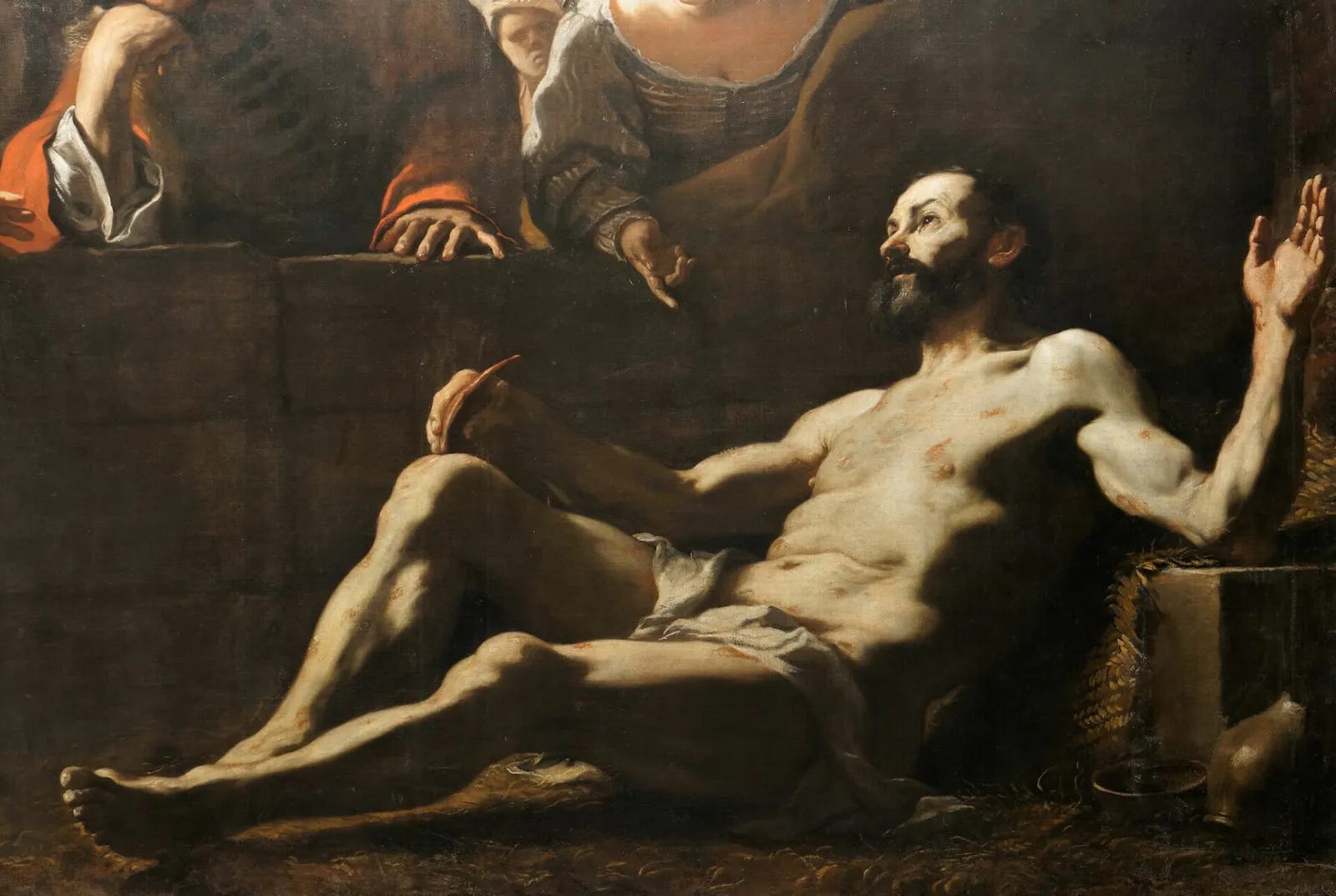
Yet Scripture doesn’t shy away from the questioning heart. Job asserts his innocence and cannot understand why he has been reduced to a lonely and childless man, sitting on a dungheap, scraping his sores with the edge of a broken pot, while his friends — some friends! — tell him that he must have done something wicked to deserve it. And from the lips of Jesus himself on the Cross, we hear the cry, “My God, my God, why hast thou abandoned me?” — and we know also that the same psalm Jesus quotes from ends in peace and comfort, for the worshipers of God shall come, and shall declare his righteousness unto a people yet unborn. It is after all the end of the story that shows us at last what all of the story before it actually was, and we, characters within the story, do not know the whole, though in a wondrous way our Author has spoken to us from without, though still in part and as through a glass darkly, what the truth of our own story was, and is, and shall be ever.
The author of our Poem of the Week, our beloved Anglican priest and poet George Herbert, often writes from the point of view of a speaker puzzled over God’s ways. That’s part of his strategy as a poet. We need not replace the “I” in the poem with Herbert himself, as if he were speaking straight from his own experience. I don’t doubt that he knew what it was to feel every passion he describes in his poetry, and what it was to think every thought he delineates. But the important thing is for us to assume the position of the speaker. Take today’s poem, “Justice (I)” — so enumerated because in the volume of poetry, The Temple, this is the first of two poems with that name; and this too is a deliberate decision on Herbert’s part, because he has conceived the entire volume itself as one well-wrought and complete work of art, with all its parts in right order. In any case, the speaker begins with a single line of iambic tetrameter, printed in regular font: “I cannot skill of these thy ways.” That means, “I can’t understand these ways you have of dealing with me.” He will then list those ways, in four consecutive lines of iambic pentameter, printed in italics, so that both the eye and the ear will set them apart. These lines do not rhyme with the first. They rhyme with each other, ABAB, and each of them ends with a pronoun, three with “me” and one with “thee,” which is appropriate, since we are thinking of the relationship between God and man — between God and the speaker.
But the second stanza — and there are only two stanzas — returns to the normal font and the tetrameter, and the first two lines rhyme with the first line of the first stanza. So we are led to look back again and then jump, so to speak, from the beginning of the first to the beginning of the second. There’s a progression, too, because that leading word, “But,” suggests a correction of the speaker’s complaints in the first stanza. Then come four lines of iambic pentameter in italics, as in the first stanza, rhyming again ABAB. Those lines too end with a full stop. But here we have a final line added. It’s the first line, but with a change in the possessive adjective: “I cannot skill of these my ways.”
Notice something else. We don’t understand God’s ways, but those ways, as we see them in the first stanza, unfold in greatness and grace. Our ways, in the second stanza, do not do so. Our ways fold in on themselves. God’s ways are bold, and that is why they astonish us and sometimes even dismay us; our ways are timorous and self-contradictory, and end in delay. Those are the ways we really should not understand. And I can tell you, my dear Readers, that I know what those are like.
     I cannot skill of these thy ways.
Lord, thou didst make me, yet thou woundest me;
Lord, thou dost wound me, yet thou dost relieve me:
Lord, thou relievest, yet I die by thee:
Lord, thou dost kill me, yet thou dost reprieve me.

     But when I mark my life and praise,
     Thy justice me most fitly pays:
For, I do praise thee, yet I praise thee not:
My prayers mean thee, yet my prayers stray:
I would do well, yet sin the hand hath got:
My soul doth love thee, yet it loves delay.
     I cannot skill of these my ways.
We think of our archive as a little treasure trove. Our paid subscribers have on demand access to the entire of Word & Song, many hundreds of entries. For everyone else, there’s always plenty to see here, as well. We hope that all of our readers will revisit and share our posts with others as we continue our mission of reclaiming — one thing at a time — the good, the beautiful, and the true.


