


The angel Raphael is describing to Adam the last and consummate event of the sixth day of creation:
There wanted yet the master-work, the end
Of all yet done: a creature who not prone
And brute as other creatures, but endowed
With sanctity of Reason might erect
His stature, and upright with front serene
Govern the rest, self-knowing, and from thence
Magnanimous to correspond with Heaven,
Yet grateful to acknowledge whence his good
Derives, thither with heart and voice and eyes
Directed in devotion to adore
And worship God supreme who made him chief
Of all his works.
What did Milton mean by reason? He certainly didn’t mean that it was only a power of mathematical deduction. That’s just one of its functions. Nor did he mean that it applied only to drawing logical conclusions from premises, though that’s another of its functions. We draw nearer to the word’s old and rich meaning when we ask what the words reasonable and unreasonable imply. If you believe that escaping all physical danger is the prime good of human life, you’ll put yourself in a padded cell, and who knows, you might have drawn that conclusion step by logical step from your premises. But we’d all agree you were being unreasonable. Your premises are faulty. They’re they out of kilter with higher things that are essential to human flourishing. But where do we get that opinion from? Not from argument. We must first see. Reason helps us to see what is good, and to reckon what is better, or how to weigh two good things we can’t have at once. It requires clear eyes and a right ordering of the passions. Man is endowed with “sanctity of Reason,” says Milton, and he really does imply sanctity. Reason at its purest and most exalted is the faculty whereby man recognizes the distance between himself and God, and his right ordering toward God. It brings you into the precincts of the Temple.
Our Word of the Week isn’t one you hear a lot these days — I mean, as that sacred power. Do animals reason? Not in that holy and intellectual sense. They are not made in the image of God. But in a lesser sense they do, as the Son says to Adam, with an amiable appreciation of the goodness of animal life, “They also know / And reason not contemptibly.” Our dog Jasper of happy memory, when our stovetop caught on fire, kept barking and barking as long as there was smoke in the kitchen, not because he wanted to get outside, but because he wanted to get us outside! He had his good aims in order: the people he loved came first. Yes, he was like that. When, in the second Star Trek film, Mr. Spock exposes himself to lethal radiation to save the Enterprise, he says that “the good of the many outweighs the good of the one.” But then in the succeeding film, those same words are turned roundabout, as Admiral Kirk and the rest of the chief members of the crew of the Enterprise put their careers and even their lives at risk to — well, it is kind of silly, but to bring the soul of Mr. Spock back into a body. They say that “the good of the one outweighs the good of the many.” In both cases, the speakers are presented as entirely reasonable, and since what’s at stake is not the same, we recognize that both speakers are to be regarded as correct. But the only world in which the latter statement can be reasonable is one that recognizes the boundaries of calculation. It’s a world in which love — which reason sees and honors and submits to — divine love, is the beating heart of all existence.
I’m reminded of a wonderful moment in Dante’s Paradise. Dante meets his sister-in-law Piccarda in the circle of the moon, the lowest of the circles. Now, these planetary and stellar circles in Paradise, as Dante learns from his guide Beatrice, are symbolic, allegorical, since all the souls are in the presence of God. They represent degrees of blessedness, but not as incompletion or deficiency. Two jars of wine can both be full, but not contain the same amount, as one can be bigger than the other. Dante asks Piccarda the “reasonable” question, which is whether she’d like to be higher up in the scale of bliss. Her reply is absolutely rational because it is founded in divine love. She says that the souls will what God wills, as love wills. Are other souls more highly honored than she is? Yes, and that for her is a source not of envy but of joy. The Italian line is one of the most famous in world literature: E 'n la sua volontade è nostra pace — In His will is our peace.
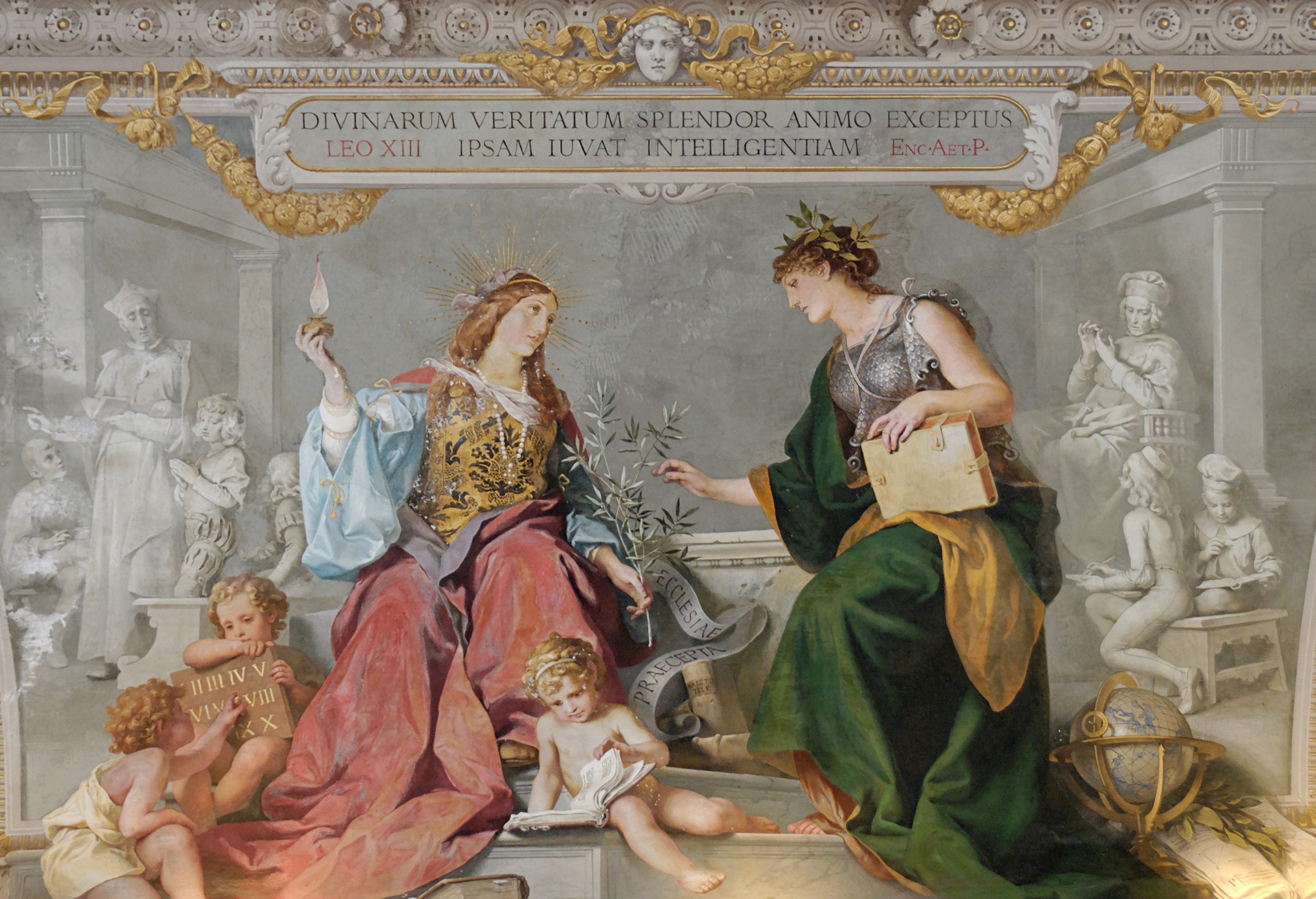
My students have often been surprised to hear me say that the phrase “Age of Reason” would apply more fitly to the age of Thomas Aquinas and Dante — the High Middle Ages — than to the deistic and atheistic salons of Enlightenment France, no matter what Tom Paine said about it. John Adams, no friend to the former, was even less of a friend to the latter. In 1805, casting a cold eye on the aftermath of the French Revolution, Adams wrote to his old friend and roommate Dr. Benjamin Waterhouse, agreeing with Waterhouse that their time should be called the “Age of Frivolity,” and, he added, he “would not object if you would name it the Age of Folly, Vice, Frenzy, Fury, Brutality, Daemons, Buonaparte, Tom Paine, or the Age of The Burning Brand from the Bottomless Pit: or anything but the age of Reason.” Whew! But maybe if we glance at the origin of the word reason we can see what agitated Adams.
Like similarly-formed words — season, fashion, poison — this one comes to us from the Norman French, from resoun, itself from Latin rationem (nominative ratio). That word had a wide range. It suggested not just a cause (the reason the Martian wanted the Illudium Q-36 Explosive Space Modulator was that he wanted to blow up the earth), or a purpose (the reason he wanted to blow up the earth was that it obstructed his view of Venus), but a reckoning up, an accounting. The Martian was being entirely unreasonable: he didn’t see the good in front of his eyes. His brain was out of balance, and that’s how Chuck Jones drew him, with a big round black head and eyes, but no expression.
Here’s an odd thing: there was a really important word in our native Old English that came from the same root as ratio: raedan, to think, to give counsel. From that root we get our word read. German reden means to talk. If you go to the Rathaus it’s not for rats, but for talk on public affairs: that’s where the town council goes to advise. And what about that poor English king Ethelred the Unready? It didn’t mean that he forgot to put on his pants. It meant that he’d taken bad advice: he listened to people who didn’t see all there was to see, and didn’t have their priorities in right order. Not a reasonable man among them!
Listen to this episode with a 7-day free trial
Subscribe to Word & Song by Anthony Esolen to listen to this post and get 7 days of free access to the full post archives.


