


Can you imagine a world without good honest cheerful hearty laughter?
Lord Chesterfield could. “A man’s going to sit down,” he writes to his 15-year-old son Phillip in 1748, “in the supposition that he has a chair behind him, and falling down upon his breech for want of one, sets a whole company a laughing, when all the wit in the world would not do it; a plain proof, in my mind, how low and unbecoming a thing laughter is: not to mention the disagreeable noise that it makes, and the shocking distortion of the face that it occasions.” I guess that does it for Buster Keaton, Harold Lloyd, Laurel and Hardy, Red Skelton, Jackie Gleason, Lucille Ball, and Dick Van Dyke! And that wasn’t an outlier for Chesterfield. “Loud laughter is the mirth of the mob,” he wrote to his boy later that year, “who are only pleased with silly things.” True wit and good breeding don’t laugh. I guess that does it for Chaucer, Shakespeare, and Cervantes!
Well, I can’t be any harder on Chesterfield than two of my heroes were. Dr. Johnson, who could laugh heartily and growl heartily too, said that Chesterfield’s published letters to his son on good breeding taught “the morals of,” ahem, a woman no better than she should be, “and the manners of a dancing-master.” Dickens, who also could laugh and growl with the best of them, has one of his oiliest villains, Mr. Chester in Barnaby Rudge, say of Chesterfield, in praise, “In every page of this enlightened writer, I find some captivating hypocrisy which has never occurred to me before, or some superlative piece of selfishness to which I was utterly a stranger.”
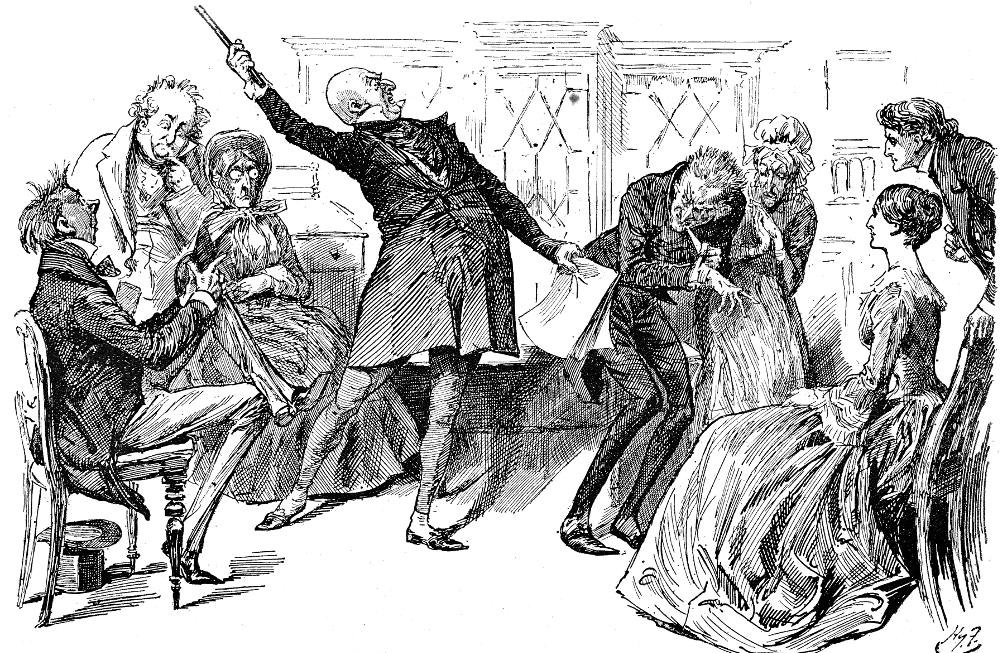
Dickens surely wanted us to laugh — to laugh at his foolish villains, but also to laugh with those madcap souls that he could create by the dozens. And sometimes you get them both at once! “You — you — you HEEP of infamy!” cries Mr. Micawber, brandishing his ruler like a broadsword, while keeping the ’umble Uriah’s fingers from getting hold of the document that is going to send him to jail. Anybody can come up with a blackmailer and a forger, though not one as memorably vile as Uriah Heep, but it takes all the great-hearted laughter of Charles Dickens to fashion a Mr. Micawber, bald, magniloquent, irresponsible, tender-hearted, and foolish, but with a human heart and a human conscience that won’t be suppressed forever.
Our Word of the Week, as you see, is LAUGH. I don’t see much carefree laughter on social media, that’s for certain. But good gracious, what would we be without it? Why, sometimes I’ve thought that half of the reason girls like boys is because they make them laugh, and boys like girls because they laugh at their pranks and jokes. “Your my bo,” writes the pretty girl to Penrod in Booth Tarkington’s novel named for that mischievous and hare-brained boy, right at the end, too, when a whole party has erupted into chaos and everybody blames Penrod for it, though for once it wasn’t him at all, but the kid everybody thought was a Little Lord Fauntleroy. I remember when my daughter Jessica and I were traveling through rural Sweden, and we’d stopped at a little restaurant in the village of Särna, a good ways up north and close to the Norwegian border. Believe it or not, I think it was the Pizzeria Capri! Anyway, a young married couple were there too, from Norway, with an eight-year-old daughter and a six-year-old boy. We got to talking about languages, since Jessica could speak Swedish, and the couple could speak English, and the daughter was studying English in school. Then I told the boy that I’d teach him some English.
“Oh no!” you say. Oh yes! Keep in mind that the boy didn’t know what he was saying. I told him I was going to teach him a very important sentence, one that he’d be likely to use quite a lot. He had to repeat after me, word by word then all together, “Your mother has large ears.” Then he glanced to his mother and father, and said, in Norse, “What did I say?” And the mother whispered it to him. You never saw such a look of surprise! Then of course he burst out into helpless laughter. It was — in all the wonderful old sense of the word — silly.
And then there’s another silly thing about the English word laughter, or laugh: the spelling! I remember the joke about English spelling, for the critter that swims in the lake: GHOTI. “What’s that?” you ask. Well, it’s GH as in LAUGH, O as in WOMEN, and TI as in MOTION. Right?
The Anglo-Saxon word was HLIEHHAN, to LAUGH: all the letters are pronounced, and there’s only one way to pronounce them. Its ancient Indo-European root was imitative — that is, the word is supposed to imitate the sound, like BOOM (not the tree on the ship, but the noise). That root has daughters everywhere, for laughing and cackling and giggling and chuckling, all of which words are also imitative. Now then, that HH in the middle of the word was a guttural, such as the Norman invaders didn’t have when they came over with their cargo of French words, and in any case, gutturals after a vowel seem to be unstable. Depending on what part of England you were in, what got spelled with a GH (or a letter we don’t have anymore, the YOGH, which looks as if a Y got stuck on a Z and couldn’t get loose) lost its guttural quality and became a G, or a W, or a Y, or — yes, an F. The F was like the old HH in the manner of pronunciation — a spirant, with a steady stream of air (you can feel it with your hand before your mouth), and with no voice (as opposed to V). That’s why we get such oddball doublets as DRAUGHT (pronounced DRAWT) and DRAUGHT (pronounced DRAFT); ROUGH and RAW;
TUG and TOW; BAY and BOW and BOUGH; SLOUGH (pronounced SLUFF) and SLOUGH (pronounced SLOW as in HOW) and SLUE.
Do I want English spelling to be cleaned up? Heck, no! It could be worse, after all — it could be French!
Listen to this episode with a 7-day free trial
Subscribe to Word & Song by Anthony Esolen to listen to this post and get 7 days of free access to the full post archives.


